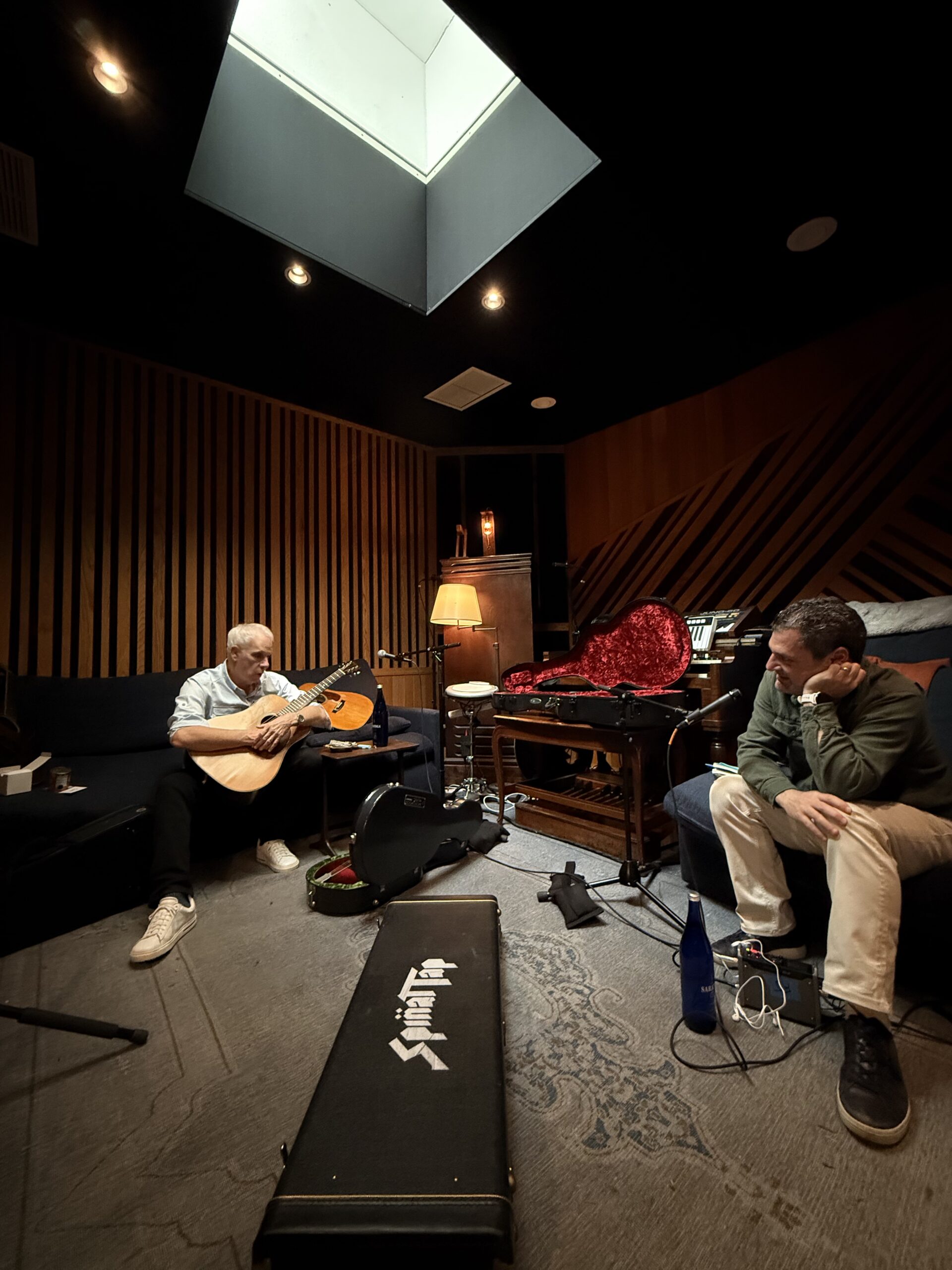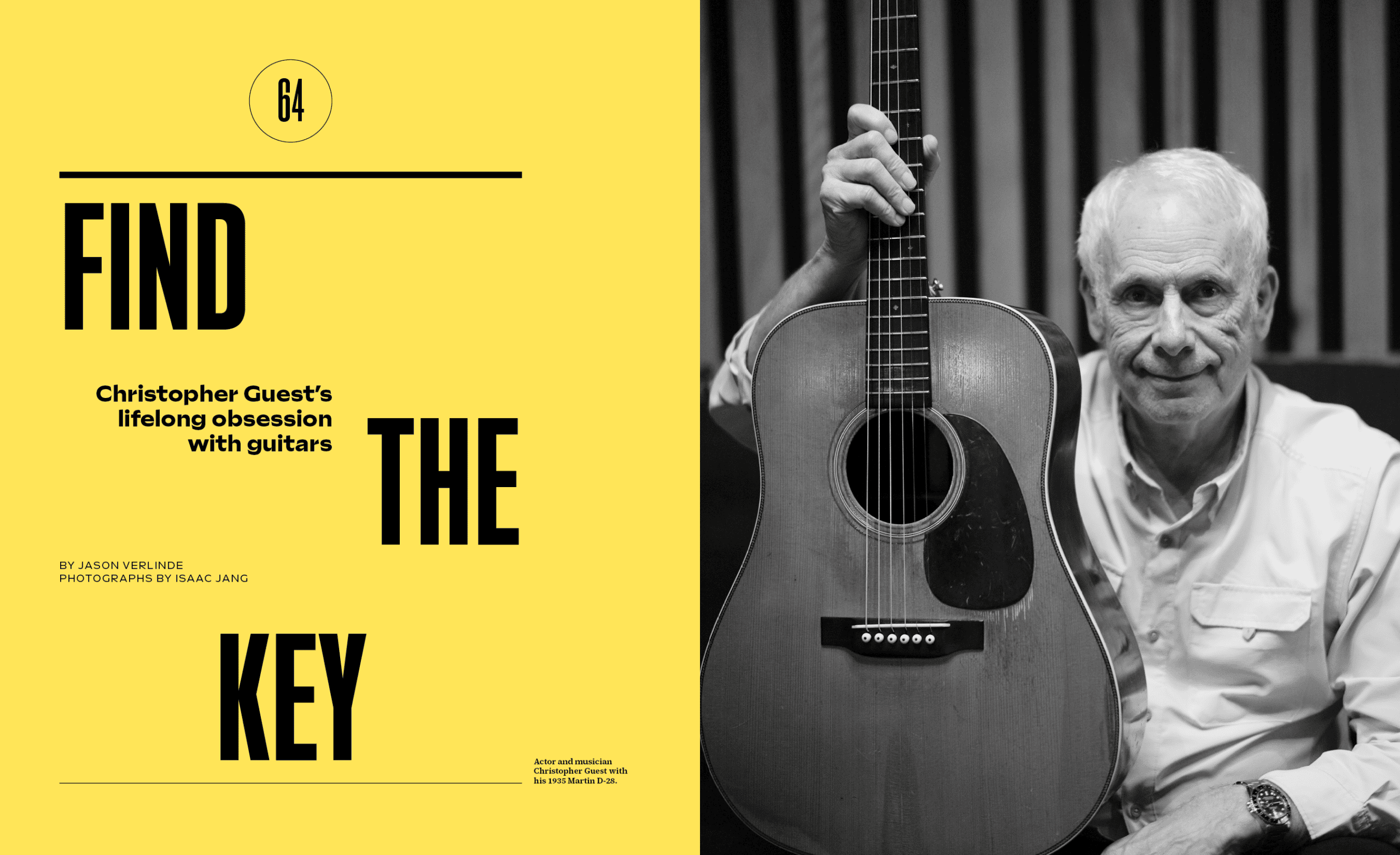
If you think of Christopher Guest as merely Nigel Tufnel (or Corky St. Clair), you’d miss the point.
Beyond Spinal Tap, Guest has been obsessed with fretted instruments since his teenage years. Over the decades, he amassed a world-class collection of instruments, including vintage Martins and Gibsons, and a Monteleone mandolin. And he still plays them all… regularly.
We sat down with this comedy legend and Fretboard Journal reader for an exclusive interview in our 60th issue, where he recounts how he once saved his Martin dreadnought from John Belushi’s destruction (not quite Animal House level intention, but still…) and walks us through some of his favorite instruments. Below are some excerpts. Order the issue here.
Folk Roots
“Pete Seeger was the music teacher at the school I went to. Dylan lived around the corner. I’m younger, but I went to all those folk clubs and played in those clubs where you could just walk in and play. I played at Washington Square, which was two blocks from my house. I listened to all kinds of music. I listened to Woody Guthrie, I listened to bluegrass music and I listened to jazz. And then I went to a school [The Stockbridge School] where I heard a rumor that Arlo Guthrie, who had not played any music publicly yet, went to. I thought, That’s Woody’s son. I should probably try to go to that school, because I think there’s a connection.”
Road Trips
“I’d heard Lightnin’ Hopkins live and B.B. King live in roughly ’67. I rode on a bicycle in 1963 with some friends, 200 miles, to the Newport Folk Festival. There were five or six of us. It’s insane when I think about that now. From Vermont, we rode on bicycles to Newport!”
The Perils of the Folksmen Opening for Spinal Tap
“We opened for ourselves several times. At the Greek Theatre, my wife took our son, who was about six. He had these airplane earphones on because [Tap] was so loud. [The Folksmen] opened, and I have this bald [wig] thing on with these little tufts of hair, and I’m playing banjo, mandolin and guitar. He turned to her and said, ‘When are the old guys getting off and the loud guys coming out?’ He had no idea.
“It was really fascinating to open for ourselves. We did it in England; we did it at Carnegie Hall and a couple of other times. You could sense, because people didn’t know who it was, ‘Get the F out of here!’”
A Love for Old Martins
“All the Tap songs were written on this ’46 [Martin D-28]. Someone had put a stencil on it here [points to the top].”
“It said ‘Rhythm Kings.’ After about 20 years, it just sort of faded away. You can’t see it. And I thought that was funny when I bought it.”
“It has the original label from Matt Umanov and his original store, which was on Bedford. I wrote the songs for the original Lampoon records on this and then a show we did called Lemmings, which ran for a year. And there was one song in the show where all the actors who played instruments switched instruments. I started playing this [Martin]. Then I gave it to John Belushi, who was playing the bass. I then had the bass.”
“John fell off the stage holding this. He did not injure the guitar, but I said, ‘We’re not going to be using this again.’ That was in 1973.”

Stomp Boxes
“With pedals, it’s a bit of a jerk-off, but it’s also interesting to me. The Chase Bliss people sent me this pedal, which is a Reverse Mode C pedal…an amazing pedal. They make great stuff, and they’re kind of insane. They’re dedicated, crazy people, really crazy, but in a legitimate, interesting way.
“The new one that just came out, which I won’t get, sounds quite remarkable…that delay [Big Time]. When I had the [pedal board] for [Spinal Tap II] built for me, about a third of those were my pedals on that huge thing in the movie. There are probably 30 pedals. I don’t know what they are. I was going to extend it so that it was 100 feet.
“I have a little board at home, a pedal board that I use, and I switch out some things. I appreciate what goes into that. I don’t understand the taking it apart thing. But I do hear what they’re doing, and there are some talented people doing that. I think good players use them, and then good players don’t use them.”
Read the entire interview in our 60th print edition, out now. Photographs by Isaac Jang.