On the morning of July 29, 2026, singer-songwriter Glen Hansard tragically passed away after a motorcycle accident in Dublin.
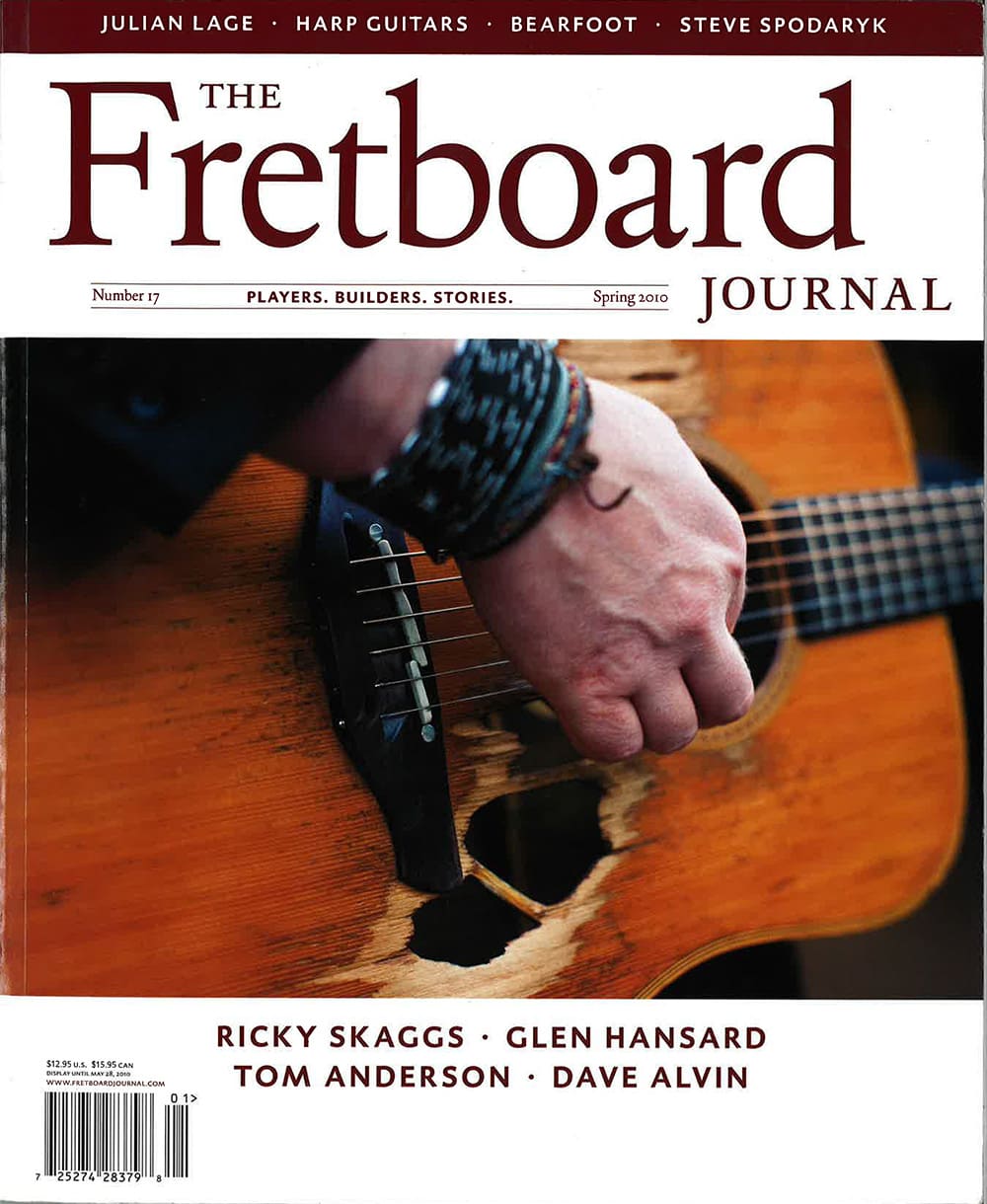
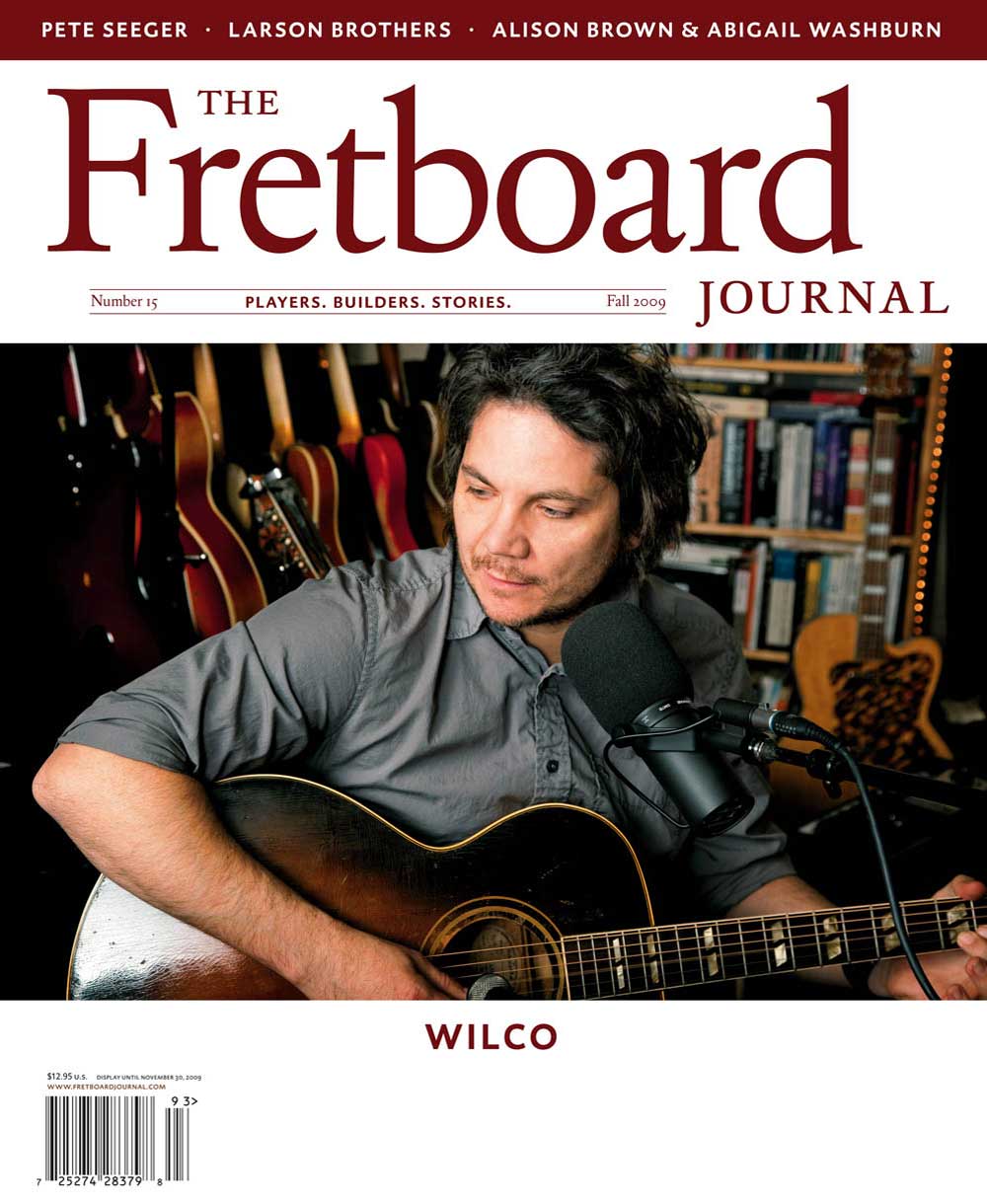
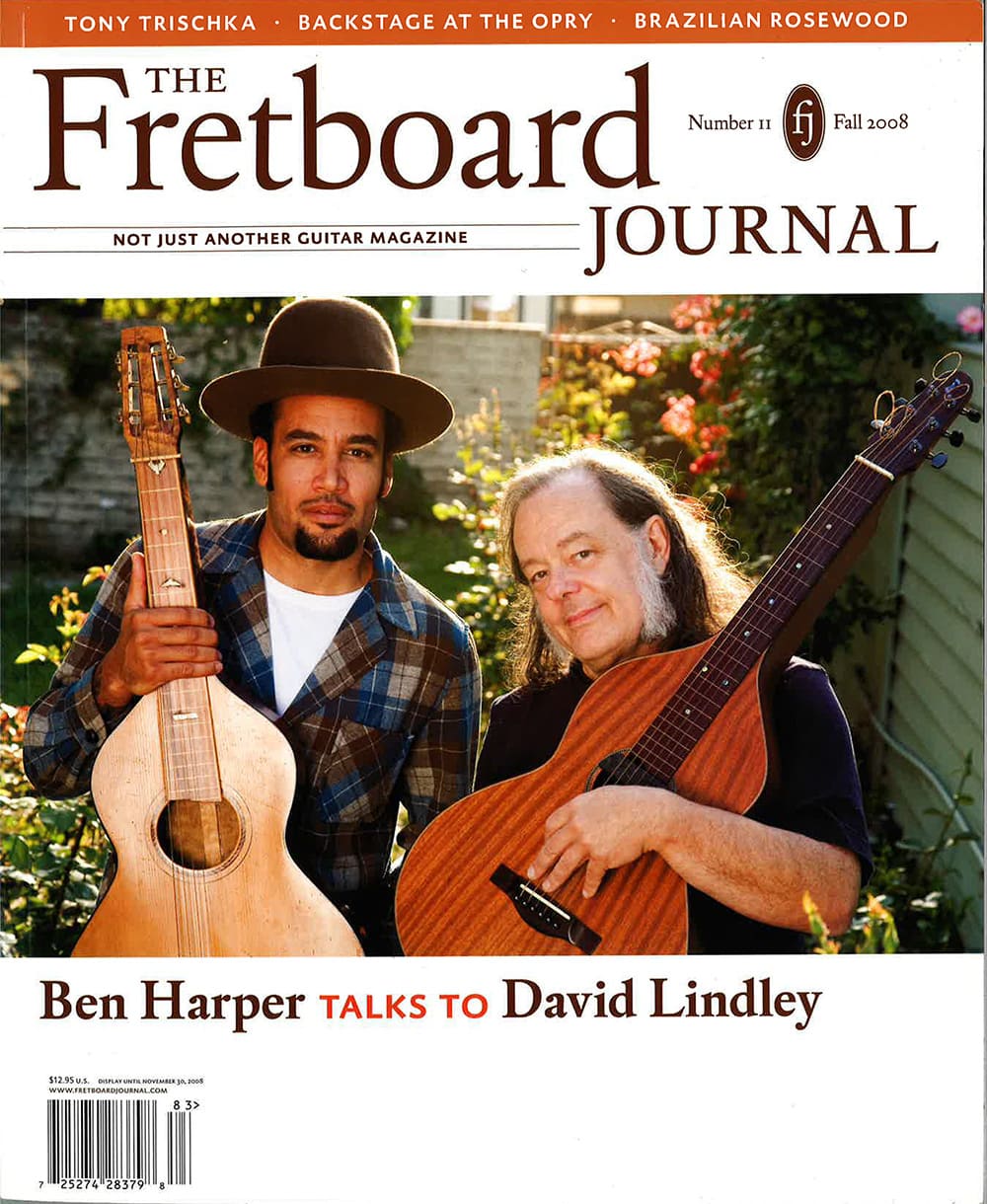
In 2009, I interviewed the Frames and Swell Season frontman for the cover story of our magazine’s seventeenth issue. Back then, he was still touring with the original, worn-through Takamine NP15 as seen in the film Once. Before his Seattle soundcheck, we sat for over an hour at Kells – an Irish pub a short walk away from the famous Pike Place Market clock and fishmongers – with Hansard sharing stories about guitars, life, busking and songwriting. We also talked a lot about his heroes Van Morrison and Bob Dylan, who, in eerie hindsight, had his infamous motorcycle accident sixty years to the day before Hansard’s.
I nursed a beer, while Glen had tea. He was a natural storyteller, which made my job easy. Photographer Maxwell Balmain took pictures for the issue.
After our chat, all three of us walked over to the crowded Market to take some outside photos. Instantly, Hansard started performing with a local busker, who had no clue who he was. The footage launched the Fretboard Journal’s YouTube channel in 2010.
Readers and guitarist friends often ask me about my favorite interview. I’ve been a music journalist for three decades and I’ve been lucky enough to interview a few real rock stars, but I always say, “Glen Hansard.” During our chat, he was utterly present, thoughtful and charming. He spoke with ease, humor and earnestness like no one else. My experience wasn’t unique: Nearly everyone who met him felt like they just stumbled upon their new best friend.
Issue 17 sold out years ago. In light of Glen’s passing, I’m sharing that interview in its entirety below.
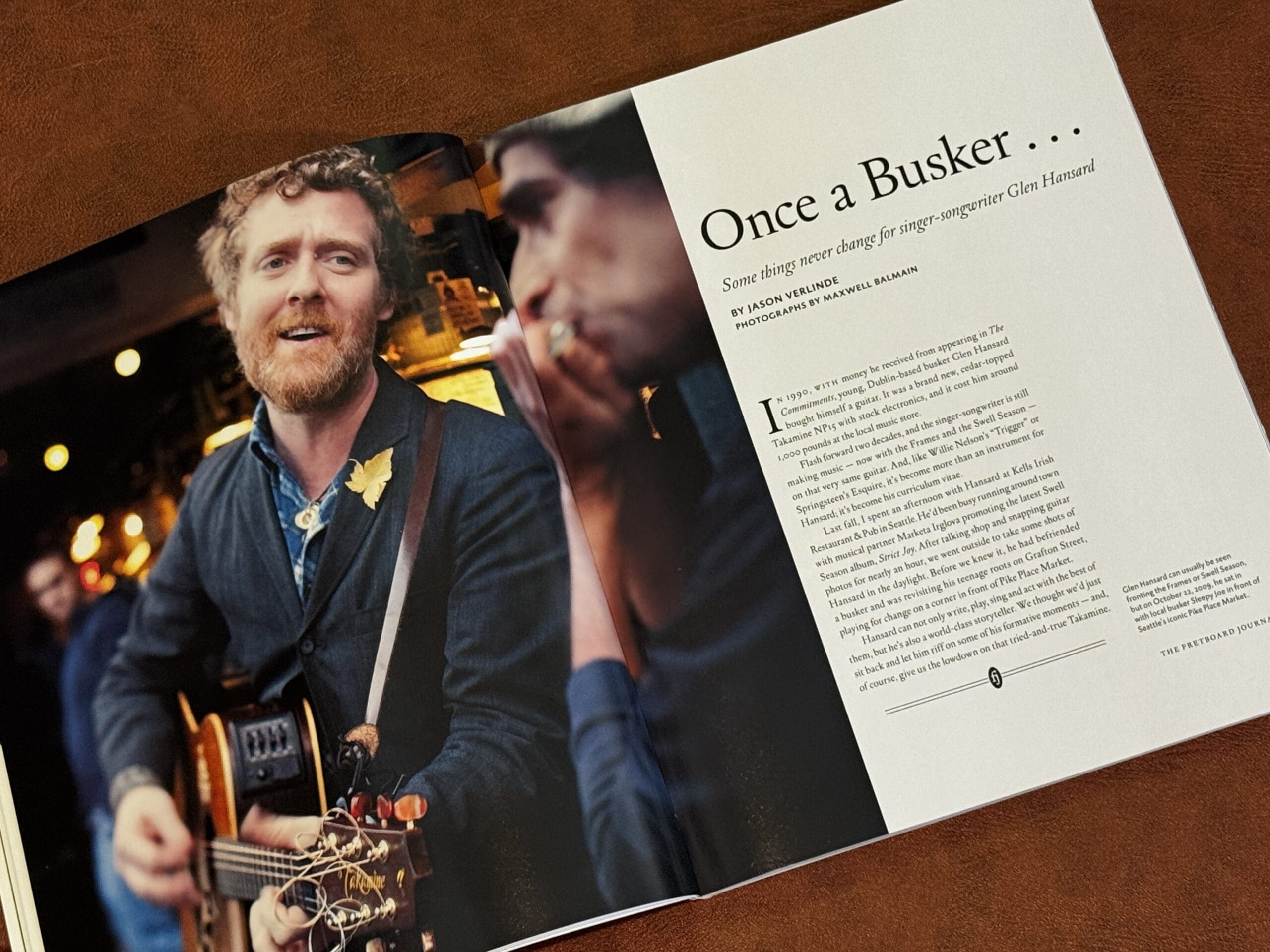
Once a Busker…
Some things never change for singer-songwriter Glen Hansard
By Jason Verlinde
In 1990, with money he received from appearing in The Commitments, young Dublin-based busker Glen Hansard bought himself a guitar. It was a brand new, cedar-topped Takamine NP15 with stock electronics. It cost him around 1000 pounds at the local music store. Flash forward two decades later and the singer-songwriter is still making music—now with the Frames and the Swell Season—on that very same guitar. And, like Willie Nelson’s “Trigger” or Springsteen’s Esquire, it’s become more than an instrument for Hansard, it’s become his curriculum vitae.
On October 22, 2009, I sat down with Hansard at Seattle’s Kell’s Irish Restaurant and Pub while he was busy running around town with musical partner Marketa Irglova promoting the Swell Season album, Strict Joy. After talking shop and snapping guitar photos for nearly an hour, we went outside to take some shots of Hansard in the daylight. Before we knew it, he had befriended a busker and was revisiting his teenage roots on Grafton Street, playing for change on a corner in front of Pike Place Market.
Hansard can not only write, play, sing and act with the best of them, he’s a world-class storyteller. We thought we’d let him riff on some of his formative moments … and give us the lowdown on that tried-and-true Takamine. –Jason Verlinde
First Guitar
When I was a kid, my uncle Paul was super cool. He was the good-looking younger brother of my mother. All the girls loved him. He was working at a theater; he played music in bars. And he was kind of like my father and hero. He taught me A and D chords when I was 8-years-old. He just loved to play, and he brought me to my first concert, the Police, in 1980. U2 opened up for them. They were all we talked about all day long.
He, unfortunately, took a job where he drove a car across Europe with some dodgy guys, and it turned out the car had stuff in it that shouldn’t have been in it. Classic story. He got locked up for a couple years in prison, in Turkey.
All of his stuff basically got left in Ireland, and I discovered his guitar. His instrument was—if I remember correctly, a Hummingbird—but it wasn’t a Gibson. I think it might have been like an Ibanez, some knock-off copy. Beautiful at the time; he adored it.
I discovered it, and learned some Bob Dylan songs on it. The first song I ever picked up was “Bob Dylan’s Dream.” I remember getting a harmonica and learning—picking up the chords … it was A, D and G.
And then I did something very ambitious. I listened to “Famous Blue Raincoat,” by Leonard Cohen, over and over and over until I figured out how to play it. I was going in pretty deep, it is a fingerpicking song. Amazingly, I took on this challenge and figured it out. A year ago, I saw Leonard play in Sydney, Australia, and I watched his hands. I was only wrong by two chords, but the rest I got right! B minor, B, A minor, F sharp minor.
So that was the beginning. Pretty soon after that, I started busking.
When he got out of prison, my uncle freaked out, because I’d knocked his guitar around. I didn’t realize! I was dragging it across the floor, and doing all the things you don’t do to a guitar. It’s only now I can appreciate that, but at the time I was like, “What is getting mad at me for?” I didn’t understand.
Guitar Heroes
As a kid, I was always interested in Angus Young. I grew up Catholic, and they make you take a confirmation, which is kind of like your bar mitzvah. You take on a new name—a saint’s name or whatever. At like 9-years-old, my confirmation name was Angus … he was my God! I guess, if I had guitar heroes, it would be him; Dylan, because his guitar playing is completely underrated; Dave Gilmore, the most amazing player; and maybe Peter Green … JJ Cale. These are all the people that I really adored.
The Takamine
It’s got a few knocks. It’s been played by many different people. I’m a big believer that your instrument is a tool; it’s no more. It shouldn’t be any more. If we identify too strongly with objects, I think we can get into an area where we get very precious.
Now, having said that, I’ve had this thing for so long, and it was always my workhorse. It was never my baby, or my “number one guitar,” or whatever. I’ve got a few guitars, but there are always two I use: a Fender Thinline Telecaster and this guitar. And I just used them both because they’re like an old pair of shoes. They work, they’re the most comfortable, and they sound the best plugged in.
But it became precious when we made Once, because then I noticed people were paying attention to the guitar. People were saying, “Oh, is that guitar you play in the film?” “Is that the guitar you’re playing on the tour?” “Is that the same guitar?” I was like, “Yeah, of course it is. It’s my guitar.” And because it’s gotten so delicate now, because the top of it is really in a pretty awful state, I realize that I’ve got a year or two—maybe three—left in it, in terms of its structure. But luthiers are pretty good at fixing stuff up, so who knows? I might have it for years and years.
I’ve become a little more precious. I bought this [Calton] case for it. I used to just check it in on a flight, in whatever case it was in. Nowadays, I’ll fight to try to get it on the plane with me. Sometimes, I’ll even buy a ticket to put it next to me!
I never thought I was that guy. You meet some people who treat their guitars better than they treat themselves. I don’t believe in this stuff, I believe the guitar is a tool—it’s an object, a piece of wood—it’s a beautiful piece of wood, but when it goes out of your life, it’s gone. And you get another one and you work with that tool.
Very, Very Lucky
I remember one night in Austria, I came out after a gig with my friend, Mic Christopher. Very drunk. I put the guitars down on the street—my electric guitar and my acoustic guitar—and got straight into a taxi, went to another part of town somewhere outside Vienna to this party. When it came time to sing a few songs at the party–two or three hours later–I’m looking for my guitar, and it’s not there! I panicked; I turned white. I ran back to the venue, and amazingly this guitar was still sitting there. There were kids going to school stepping over the guitar! And it was like late at night when we left the place! It was there on the street. My electric guitar was gone; someone picked it up and took it. I had it since I was 15.
But the electric guitar showed up two weeks later, standing against the venue wall. The venue owner came in to work one morning, found it, brought it into the place, and rang me, “Your guitar just showed up, completely untouched, still in tune.” So someone had picked it up, heard that this guy had lost it, and basically felt guilty and brought it back. It’s very, very lucky.
I think for other people this [Takamine] might just be a bit of a plank. But for me, it’s exactly what I need. For them, I don’t know. But it’s like a thousand people have played my guitar, because if we’re on a session and someone wants to sing a song, I just hand it over. I don’t think about. Maybe they’ll break it, and sometimes people do treat it more rough than I’d like them to—but that’s all a part of all my instruments; that’s what they’re for.
Busking for Dummies
I’m not a purest, but there’s something about guys who use a microphone (or amplifier) … not that they’re cheating, but they’re not going to learn as much doing it that way as they will by having to project raw.
That was the biggest lesson I learned: projecting raw. I remember I listened to Before the Flood, where Dylan sings “Just Like a Woman.” I remember making it my goal to be able to sing like that. On Grafton Street, like any street, learning how to project your voice to the point to where it bounces back at you was the goal. And it was all about learning how to play loud, and fast—in that way I noticed I had made more money.
The most lucrative day of the week was always Friday and Saturday night, when everyone was drunk, but that also meant you were going to face a lot of madness as well. It can be very tough, but an education. A baptism of fire.
That guy at the beginning of Once, who steals my money? There was a guy I knew that used to do that. On the street you meet everyone: you know who the pick-pockets are, you know where the whores are, you know who the drug squad are. You figure them all out. If you stand still on any street in the world for long enough, every person in that city will pass you by.
Into the Mystic
When I was busking, one of the people that I became very friendly with was Marina Guinness. She was of the brewing family and she knew I loved Van Morrison, because she heard me singing his tune. She said to me one day, “You know, Van is having this party—his 50th birthday party—at my house. Why don’t you come along?” I said, “What?” “Come along. Take it easy. Don’t make a big deal of it. Bring your girlfriend. Bring a bottle of Port. Treat him with respect, because we’d love for you to come.”
So, I was overjoyed with the opportunity. Her place is way outside the city. I drove out on my scooter with my girlfriend; it was late, and we got there, and we got in. And I thought it was going to be a party, but it wasn’t 20 people. It was Van sitting with just a few friends. And I was introduced to everybody, sat down, we ate some food … just being quiet and sort of being in the background.
It was amazing; I’m sitting here with Van Morrison! And a couple of drinks were had, and then someone came into the room we were in and said, “Everybody, come on into the kitchen… Van is singing some songs.” Van was there with Jerry Lee Lewis. And Jerry Lee and Van are standing at the fireplace, and they’re both singing beautiful old country songs—beautiful.
At one point Van says, “Anyone want to hear a song? Any requests?” I’m a huge fan, but I didn’t know whether I should say it, or whether I shouldn’t. No one else was shouting out, so I said, “Van… ‘I’m Hungry For Your Love’?”
“I’m Hungry For Your Love,” is a great song, but a fairly lesser-known song.
He looks at me, and he says, “You don’t know me!”
I was just like, ‘Jesus Christ!’ I turned away, and I walked outside. I kind of freaked out. The first thing I’d said to him, and I just got BAM!
So I went outside, and I was thinking about taking my head off, thinking I just shouldn’t have come here. And Marina came out, and said, “Glen, come on. Don’t let that get in the way. Come back in, have a good night. Relax!”
So I went back in and stayed at the back of the room, and just enjoyed listening to him. He said, “Anyone else want to sing a song?” And Marina said, “Glen … Glen will sing.” And I was like, “Oh, no!” Freaked out, you know?
I went up and he handed me the guitar, stood up and walked out of the room. I was like, “Oh, fuck!”
So I sang a song and there was nobody else to play, and people asked for another one, so I sang a second one. He comes back in, and sat down with his back to me. And I finished my second song, and he swung his chair around, and he said, “What did you want me to sing?” I said, “Hungry For Your Love.” And he says, “Do you know it?” I say, “Yeah.” He said, “Well, play it,” and he put me on the spot. And thank God I know his songs.
So I played it, and he’s listening to me, and about halfway through the song he starts going, yeah … yeah, and then sings a little harmony with me. I’m blown away. I’m flipping freaking out. I’m singing his song, and he’s singing harmony to me.
And then I finished that song, and he says, “All right. Come on.” I said, “Where?” “Just come on, follow me.” He brings me up the stairs of this beautiful old house, goes into one of the rooms, and sits me down on the couch. He was ready to sing. He sits down opposite me. He’s had a few drinks, and he should be downstairs mingling. And I start playing one of my songs.
He listens to it, he picks the guitar up. He says nothing. I say, “Well, will you play me ‘Hungry For Your Love’?”
He plays it, hands me the guitar. He plays a second song, takes the guitar. “What do you want to hear?” And we pass the guitar, and I’m not kidding you, for hours we passed the guitar. We ran out of songs after an hour-and-a-half.
The sun was coming up, and I remember his girlfriend at the time came into the room at the end, and said, “Come on, we have to go.” And he’s like, “Right.” And he stood up, comes over, pats me on the shoulder, and says, “Nice voice. Nice songs. Blah, blah, blah,” and walks out. And that was it. That was my encounter. That was all he said: “Nice voice. Nice songs. Blah, blah, blah.”
But what was amazing for me, the gift that I’d been given that night, was that I got to watch his hands. I got to watch his neck. I got to watch how he lifted his head into notes. I got to watch how his body leaned into chords.
I got to see Van the way no one probably gets to see him, except maybe his girlfriend, or his kids, or whoever. I got to see a master up close, and to digest every inflection—to use or not use—in my own palette all this experience. Do you know what I’m saying? I went to be being a proper apprentice that night. The education was profound because it was up close and personal with a master.
Meeting Dylan
I was busking and Dylan was in Dublin to do a gig, which, of course, I was going to because I’m a huge fan. He was number one. He was staying at this hotel, the Westbury Hotel. I was down the street and someone comes out and goes, “Bob-Fucking-Dylan just walked out—got out of the van around the corner!”
I just grabbed my guitar and ran … left the money in my case, everything there. I ran around the corner and Dylan was getting out of a truck. He was hanging out, going into the hotel. And I did this stupid thing: I just took a harmonica out of my pocket and I handed it to him. It was a stupid thing to do, give Bob Dylan a harmonica, but he took it, and he was like, “Hey, thanks.”
And that was it; he was gone. But the weird thing was maybe a year or two later … I was rehearsing with my band, and Dylan was rehearsing next door with his band in the rehearsal place we were in, because they were beginning a European tour. We finished our rehearsals, the drum and bass player had gone home, and I was running over one last song, and we didn’t know he was rehearsing next door, because all we were told was, “There’s someone famous next door. Don’t annoy them. Stay out of the way.” We didn’t care. We thought it might have been U2.
But at one point, Colin, our violin player, just looked at me like someone had died, and we turned around, and standing in our doorway was Bob with his foot up, and he’s smoking a cigarette, and he just says, “Sounds good.” And I walked up to him, and I just said, “Bob,” and I shook his hand, and was totally freaked out.
He shook my hand, and I said, “Bob, meeting you [for me] is what it must have been like when you met Woody.” And I think I must have said the right thing, ‘cause Bob was like, “Oh, Woody! Man, Woody was amazing!” He said, “I never got to hear Woody play.” And Bob starts talking … Bob Dylan started talking to me about Woody Guthrie! And I knew just enough about Woody—through Dylan—to hold a conversation with him.
We talked for a minute-and-a-half about Woody Guthrie, and he took off. And I shook his hand, and I ran home. I told my mother I’d shook Bob Dylan’s hand. It was unbelievable.
The next morning, a phone call came in to the rehearsal space. They gave Bob Dylan’s manager my number, and he rang up, and he said, “You must have impressed Bob. Do you want to come to London and open for him?”
It was amazing; he was like, “Can you get a flight? If you can get a flight, you can do the gig.” That was basically how he put it. We went out to the airport and explained our situation, and they canceled five people off the flight for us! We walked on stage, and I said, “Yesterday, I was rehearsing with my band to Dublin, and Bob Dylan appeared in the doorway, and we chatted for a few minutes, and here we are. This is amazing.”
Keeping It Road Worthy
A few months ago, a luthier contacted me via email about fixing my guitar for me. I really wasn’t sure how I felt about it. We were in L.A. and doing press, and he lives an hour’s drive south, and we went down, and we visited him. He asked me to leave the guitar with him for a couple of days, because he just wanted to observe the inside of it. He asked me how I felt about him reinforcing the part where it’s all damaged.
I took a risk, and I left it with him. I came back a couple of days later, and he had done this kind of amazing job, where he had basically put a very thin layer of wood underneath the holes, which basically means that the holes may not grow anymore.
But he didn’t change the aesthetic at all. He wanted to put lacquer—some sort of resin on the holes, which would have made the wood darker, and which would have meant I wouldn’t be able to wear the guitar down anymore.
But I didn’t let him do that, because I think there’s something very natural about the way the thing is. I didn’t want to change anything. But the reinforcement inside me was very happy with. He did an amazing job!
Marketa was amazing. I was kind of weird about [leaving my guitar with a stranger], but I wasn’t saying that. Mar just turned to him and said, “If you fuck up that guitar, I will kill you!” She really had my back.