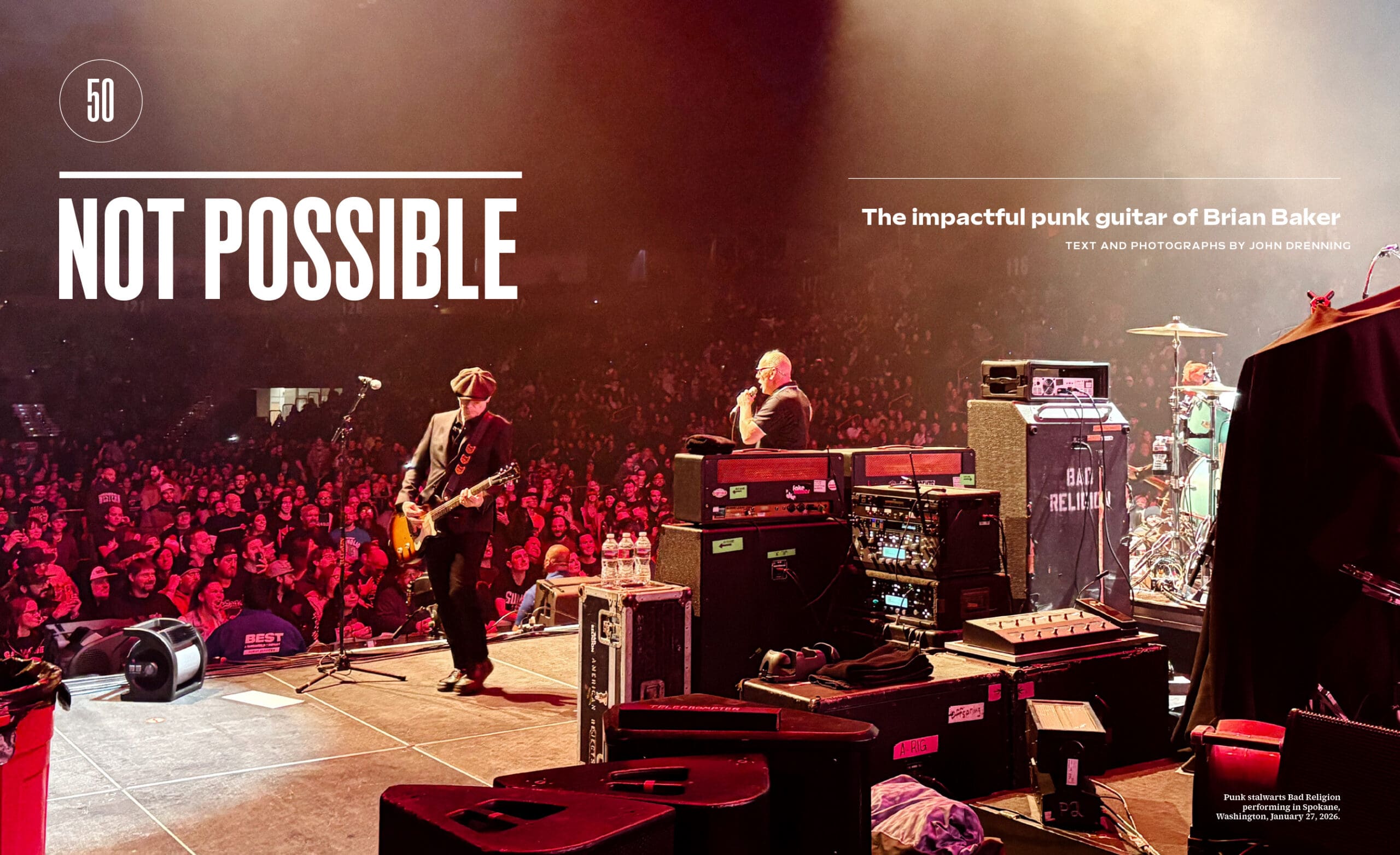
In our 60th issue of the Fretboard Journal (out now), John Drenning sits down with Brian Baker of Bad Religion/Minor Threat fame. The result is an 8,000-word interview that spans some 14 pages of our magazine. As a reader-supported publication, we seldom post stories online, but we thought we’d share a few choice excerpts for all to see. The complete article can be purchased here. -Editor
What’s the point of asking a guitar player their influences? It’s like asking someone their top five albums; it very quickly becomes an exercise in taste and curation. What does it say about me if I name Tom Verlaine instead of Ace Frehley? It’s more honest to think in terms of musical DNA: the guitarists who, when you come up with a riff, you realize they already wrote it; the ones who were the godparents of your own style because you couldn’t do what they did. This imitation isn’t self-conscious. These are the players who made you want to play, and taught you how. Tastes change; DNA doesn’t.
Have you ever met one of these players? What would you say if you did? I met Brian Baker by chance in 1993, backstage at the Whisky. Brian wasn’t just in one of the bands that was most important to me when I was a teenager just a few years prior, learning to play, write, and gig. He was in two of them. There is no question I’d play guitar differently, and maybe even be a different person, if I’d never heard those bands.
I introduced myself and asked what he was doing musically. The man couldn’t have been nicer. After some chitchat and feigned nonchalance, I told Brian his guitar playing and the songs he wrote were more important to me than I could begin to explain, and I just wanted to thank him for that.
He thanked me, very graciously, and then said: You should hear the other guitar player in my band.
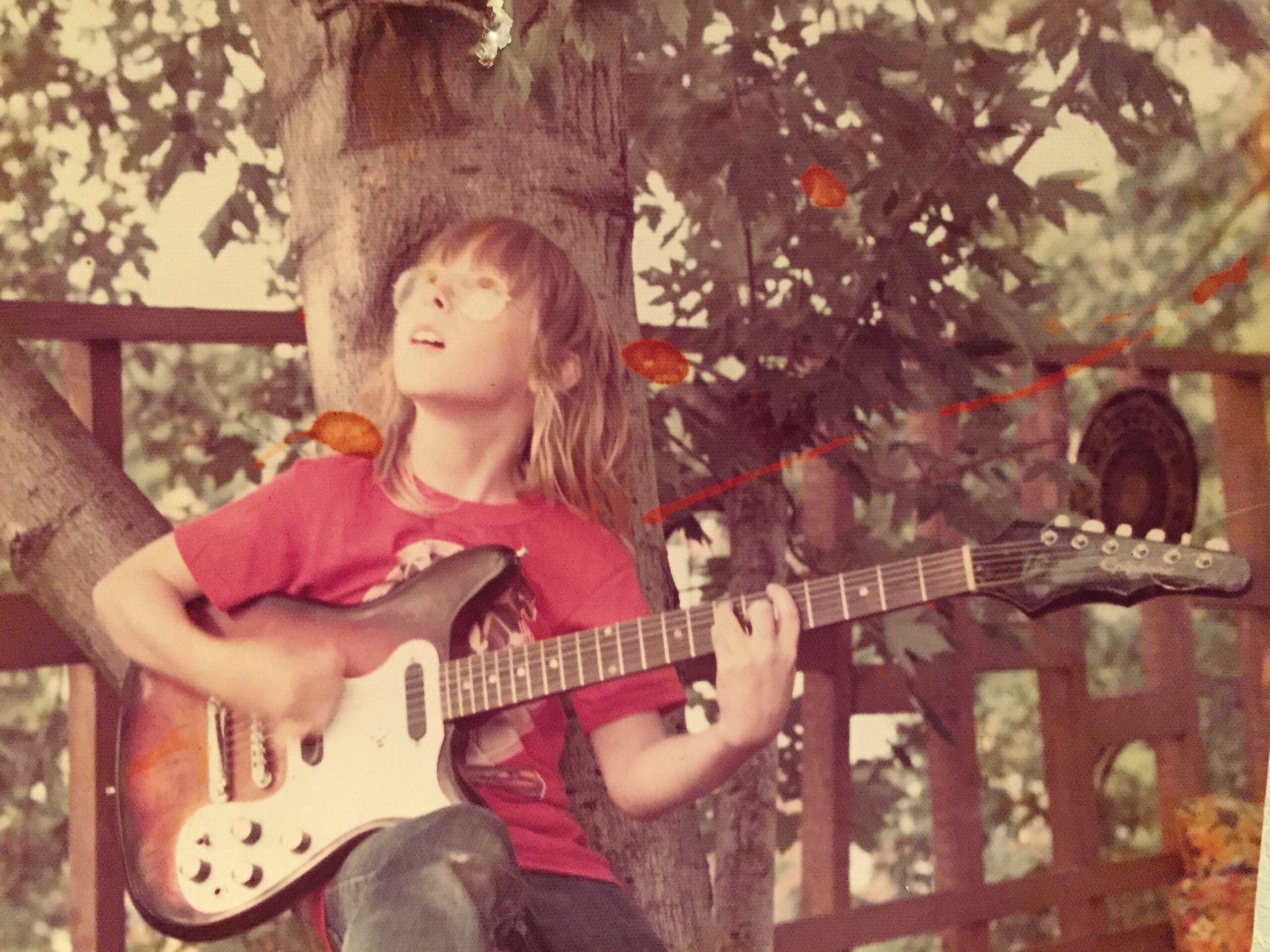
Over 30 years later, Brian describes his own talent the way Fonzie apologizes: hesitantly, and under duress. “It was one of those weird things: I could play guitar in a weirdly good way for a very small baby boy…good enough to where it was like a carnival act.” Early influences—DNA, if you will—were “Angus and Malcolm [Young], Billy Gibbons, Eddie Van Halen…My debt to Angus is immeasurable, but if you truly understand Malcolm — talking about him gets me emotional; he’s that good.”
Brian took lessons as a kid, but wasn’t a serious student — “I was a child, and I wanted to skateboard.” In 1978, when he was 13, Brian went full Frehley and added a third pickup and two toggle switches to his Norlin-era Les Paul Deluxe, because it was 1978, and he was 13. Instead of cranking his first amp, a Princeton, or using a pedal for distortion, Brian plugged the speaker into the extension speaker jack. (Amp guru Andy Marshall told me that when you plug a speaker into the external jack only, the main speaker out becomes a “dead short,” and 95% of the amp’s power goes to ground. Per Andy, don’t try this at home unless you like the smell of smoke.)
Brian told me that by ninth grade, “guitar was already my personality, and my entree into polite society.” Guitar was also his entree to the stage at Detroit’s Cobo Hall, where he jammed onstage with Carlos Santana in March of ’79, the month after he turned 14. Did he think at this age he would play guitar for a living? “No, because that’s not possible…I was going to go to college, because that’s what one does.” But then, “almost accidentally,” Brian became a founding member of the most influential high school band of all time.
Minor Threat was one of the first D.C. hardcore bands, which means it was one of the first hardcore bands. As Michael Azzerad put it in Our Band Could Be Your Life: “Black Flag may have been its godfathers and the Bad Brains may have revved up its tempo to light speed, but hardcore has no more definitive band than Minor Threat.” In 1980, Lyle Preslar asked his classmate Brian to play bass. Then 15, Brian had “gone punk” shortly after moving back to DC from Michigan. “I was just one of the few people around who wasn’t already in a band, and knew how to play an instrument. That’s how I got in. I cut my own hair, and I knew how to play guitar.”
Minor Threat didn’t last long—very few of these bands did—but they developed fast, and by the time I discovered hardcore in 1984, a year after they broke up, they were one of the genre’s defining bands. Their eponymous first 7″, with eight songs, runs a little over nine minutes. As Bad Religion co-founder Brett Gurewitz said, 1981’s Minor Threat “set the rule book. It showed how fast, and how tight, hardcore can be, and what it should be.” It was ground zero for straight edge, which altered the trajectory of a lot of kids’ lives, mine included. Later that year they released their second 7″, In My Eyes, having grown rapidly in the intervening six months. Describing songs like “In My Eyes” and “Look Back And Laugh,” author Ben Merlis jokingly called it “prog-ified hardcore—let’s make a three-minute song with lots of parts, but still have it be really hardcore and still have it be really catchy. Good luck doing that. Look how many lesser bands tried copying that later, and it didn’t work.” As a teenage member of one of those lesser bands, I can testify that while the exact recipe was impossible to recreate, the general approach scaled well.
Minor Threat recorded Out Of Step in January 1983. The nine-song EP, 15 seconds shorter in its entirety than the Yes song “The Gates Of Delirium,” has cast the longest shadow, but by this point the internal pressures in the band had become unsustainable. Their last show was September 1983. How do you know your hardcore band is breaking up? Your guitar player sells his Marshall, and buys a Roland Jazz Chorus.
Brian has always been forthright about his belief that, as he told me, “If I hadn’t been in Minor Threat, I do not believe we’d be having this conversation.” If Preslar had asked a different classmate to play bass in his high school band, it’s not hard to imagine Brian as, say, an American history professor. And Brian is quick to credit singer Ian MacKaye’s focus and foresight as key to Minor Threat’s lasting influence. “I was lucky enough to be close to someone with that vision and skillset… those of us who were lucky enough to make records with him when we were very young go on to have conversations with John who’s in Seattle right now for Fretboard Journal.” I don’t believe this is false modesty. The music industry is bleak.
And yet. Seneca: “Luck is what happens when preparation meets opportunity;” Picasso: “Inspiration exists, but it has to find you working.” Etc. Brian may be the most influential musician in the genre, and his playing easily passes the Les Paul test: asked about the hyper-technical shredders of the 80s, Paul responded, “but when they’re on the radio, can their mother tell it’s them?” And multiple collaborators described how Brian’s intuitive contributions could improve their material: he occupies that rare shared territory between technical excellence, which usually arises from ego, and an egoless ability to make the song better. If punk has a Mike Campbell (who has played on two Bad Religion tracks), it’s Brian Baker.
I asked Brian if he thought in his teens and twenties that he could be a professional musician. He responded, “I didn’t know I could do it for a living until I was already doing it for a living.” By then he was in his 30s and had been in Bad Religion for a couple years, and would get home from tour and not have to get a day job. He’d been touring half his life by then: longtime friend and current Fake Names bandmate Johnny Temple (Soulside, Girls Against Boys) told me he and Brian were in high school chemistry class together, and he remembered “Brian leaving class to go on tour with fucking Minor Threat.” Brian said, “There are times when I should have just stopped, but I didn’t know, I just kept going.”
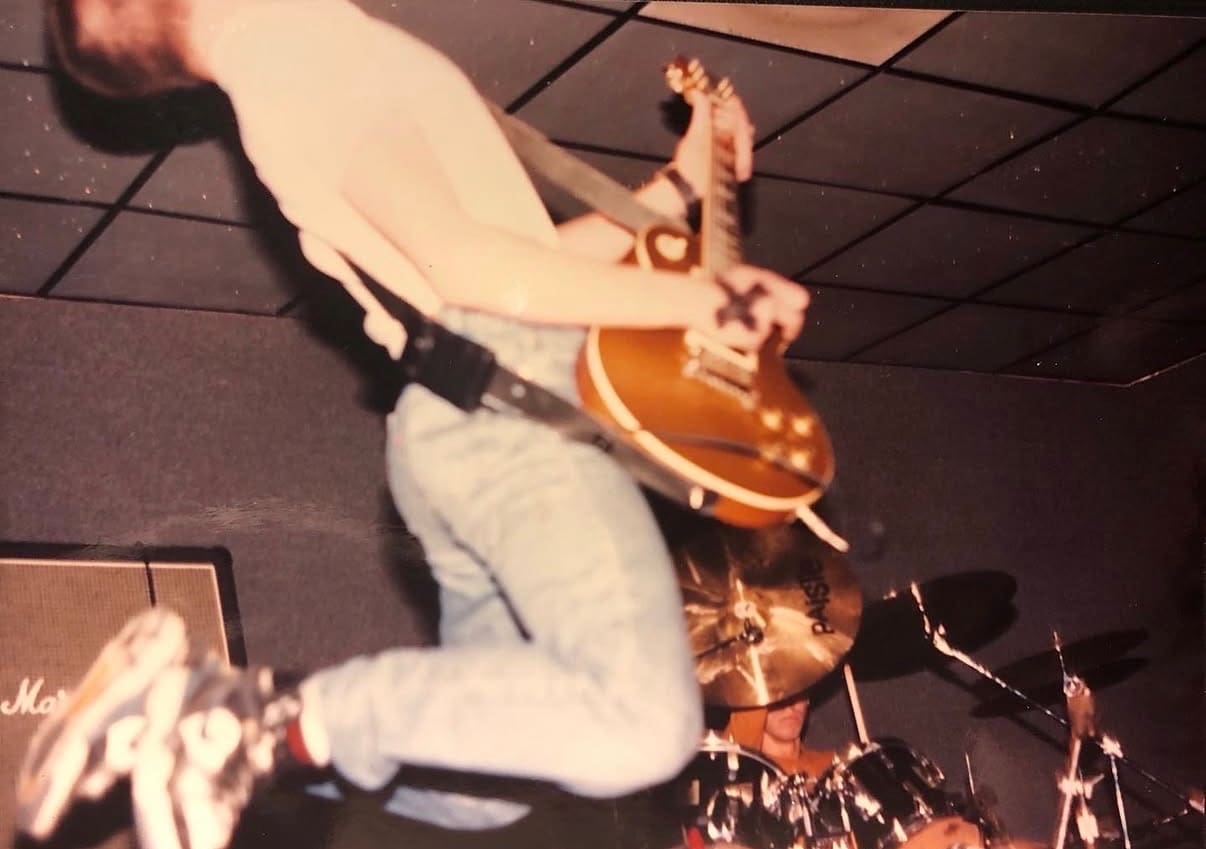
Formed in 1985, Dag Nasty was the second legendary band Brian was in, but was the only band where he was the primary writer, sole guitarist, and, for a time, lyricist. (Brian would be equally comfortable having the descriptor “felon” in the same sentence as his name as “legendary.”) Their first album, Can I Say, was recorded and mixed with minimal overdubs (Brian: “Did we all make it through? OK, let’s keep that take”) in about 20 hours the following year. Brian used his regular gigging rig, as anyone would have on a punk record at the time: an early-70s Les Paul Deluxe Goldtop into a 100-watt ’78 Marshall JMP100, along with an MXR M-134 chorus pedal that was lying around the studio.
Can I Say has the visceral punch of Out Of Step. But the songwriting is revelatory, the well-rehearsed band having shaped Brian’s riffs into songs that didn’t conform to the hardcore mold. The rhythm section of Colin Sears and Roger Marbury was seamless, packing more low-end punch than their hardcore contemporaries. Dave Smalley’s vocals were delivered with uncommon conviction, perfectly blending melody and power. And the lyrics are, well, emotional, not what subsequent Dag vocalist Peter Cortner called “made-to-order anthemic lyrics.” Ben Merlis told me, “The songwriting is incredible; just the right balance of melody and aggression. The recording sounds impeccable—it sounds fresh, and it sounds like you’re in the room with them.” Pete Chramiec, guitarist for Verbal Assault, described hearing Dag Nasty and “immediately turning the ship in that direction. It was a necessary course correction, that you could be way more interesting, and way more musical. We were already getting sick of the macho shit.” End on End podcast cohost Jeff Kaplan told me: “There were already traces of melody in hardcore, including Minor Threat. But Can I Say is the point where you could say, this isn’t just hardcore that’s experimenting with some melodic elements; this is the record that invents melodic hardcore. And I feel like hardcore, even with Minor Threat, had to have this toughness to it, even though Minor Threat weren’t your prototypical tough hardcore guys. It wasn’t macho, but there was still this tough edge to it. Whereas with Can I Say, it was okay to be vulnerable. For the first time in hardcore, we don’t need to be so fucking tough.”
Can I Say is where Brian’s distinctive playing style fully emerged. Like another much-“borrowed from” player, Stevie Ray Vaughan, it’s not that his style was unique; instead, like SRV, Brian was able to meld a variety of pre-existing techniques into one cohesive package, and then execute it with feel, technical precision, and originality. And as with SRV, countless pale imitations ensued. (I was a pale imitator of both.) Brian drew from the deep well of Captain Sensible (i.e., the single-note lines), George Harrison (i.e., the riff-based melodicism), and Malcolm Young (well, Malcolm fucking Young), rather than cookie-cutter punk players, but took those influences in an entirely different direction.
No single part of Brian’s style is revolutionary. What made it unique was doing it all, in tune and in time, in service of the song. Brian Gathy, founder of End On End, told me, “It was all about his choices. He didn’t sound superhuman, but he was so laser-focused in his choices…Every guitar part on Can I Say supports the bones of the song.” Jeff Kaplan remarked that “if we had to pick one record in his entire catalog where we said, this is the defining artistic statement made by Brian Baker, I think it has to be Can I Say. Brian was playing at a different level than his peers. He brought a level of tightness, a level of discipline, that was so rare in hardcore in the early-mid 80s. And he was about the song first—you can be this really great guitar player without making it about you, and instead, just make it about the song.”
Dag Nasty, like Minor Threat, had about a three-year run. After two more albums and numerous lineup changes, Dag played their last show in July 1988. The wind had gone out of the sails. And Brian had run into Chris Gates—formerly the bassist of the Big Boys, who Minor Threat played their last show with in DC, not quite five years ago—in the parking lot of an L.A. 7-Eleven. Gates was playing guitar in Junkyard, recently signed to Geffen, and short a guitar player. The switch from melodic hardcore to Skynyrd-meets-Motörhead rock was not a premeditated career move by Brian; he just wanted to keep playing guitar. In their book on the exploding 1980s L.A. hard rock scene, describing the intense competitiveness of the genre, Tom Beaujour and Richard Bienstock observed that “no one stumbled into this (okay, maybe Brian Baker of Junkyard did).”
As Brian pivoted “mainstream” with Junkyard, and hardcore obstinately stayed put, “alternative,” or “college rock” as we called it back then, was pivoting mainstream, too. This was well underway before the release of Nirvana’s Nevermind in September 1991. This arc is best captured by the ur-college rock band, REM. Document, in 1987, sold a million copies, almost doubling the previous year’s Life’s Rich Pageant. 1988’s Green more than doubled the sales of Document, at 2.6 million. Out Of Time, released six months before Nevermind, sold 12 million copies; next year’s Automatic For The People sold 18 million.
When I met Brian backstage at the Whisky in February 1993, a year after Junkyard’s demise, Peter Buck was also backstage. Neither Brian nor I remembered this, though REM bestrode the earth like a colossus at the time. A year later, Brian was REM’s second guitarist.
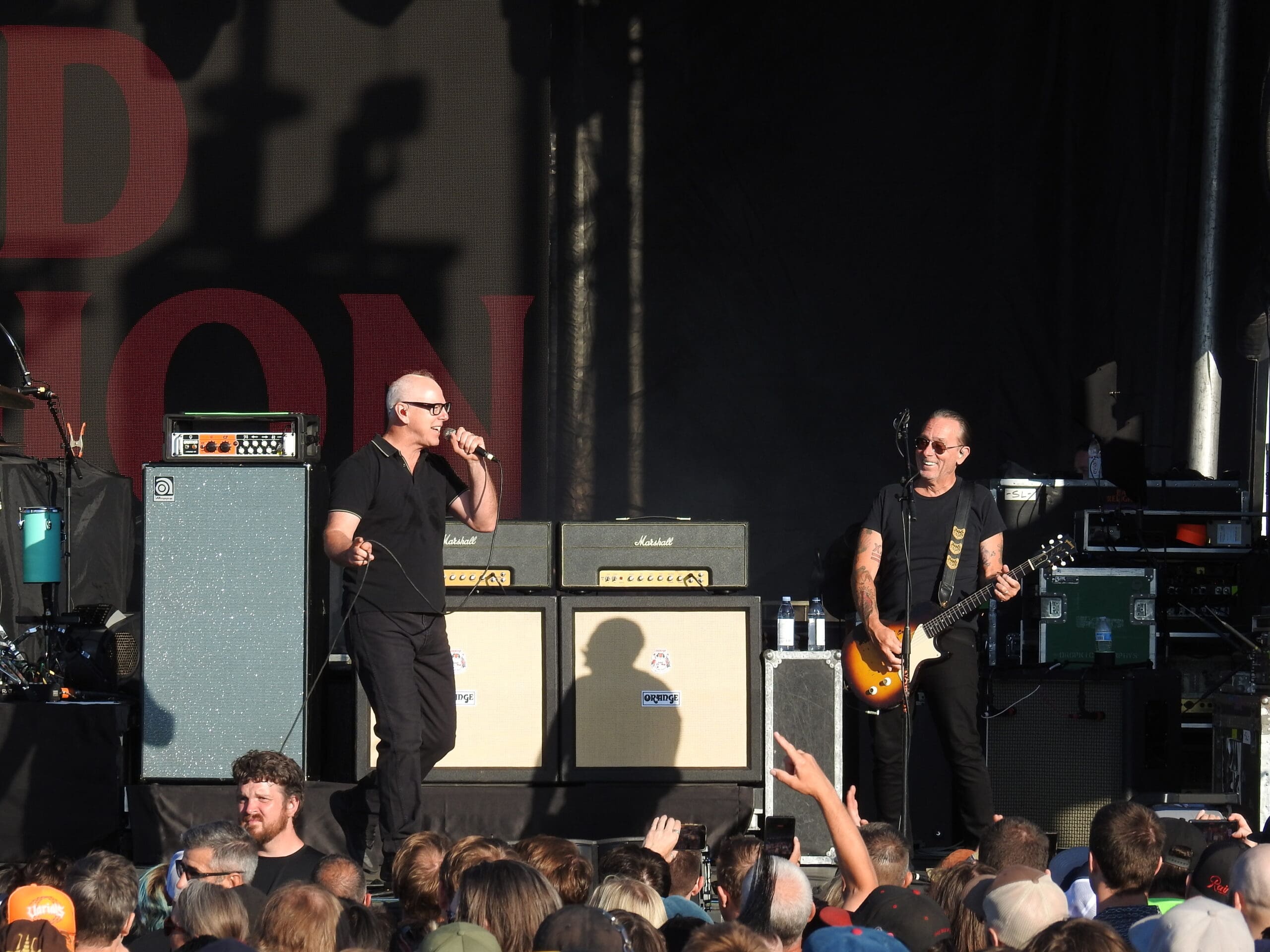
Except, he wasn’t. Shortly after accepting the gig as REM’s touring guitarist, Brian was offered a job as a card-carrying member of Bad Religion. Brian’s chair in Bad Religion had previously been occupied by Brett Gurewitz, founding member and one of the chief songwriters. This is kind of like being offered John Lennon’s spot in The Beatles. In Jim Ruland’s book on Bad Religion, bassist Jay Bentley explained: “When someone leaves the band and people want to know what happened, my answer is, ‘You’ll have to ask him.’ But when someone like Brett leaves and you’ve lost one of your songwriters, you can’t just go, ‘You’ll have to talk to him’ because that’s not going to fly. So having someone like Brian Baker from Minor Threat helped get us out of that awkward conversation. ‘What happened? Here’s Brian!’ It buffered the situation without completely ignoring that we’d lost a major player in our band by replacing him with another major player.”
Hardcore is as obsessed with lineage as the Old Testament. Greg Graffin, Bad Religion’s singer, wrote in his memoir Punk Paradox that a minority of the band’s fans expected the band to fall apart in Gurewitz’s absence. Brian’s pedigree got him in the door, but doesn’t explain why he’s still there: “Once those naysayers realized ‘That’s Brian Baker up there,’ the credibility portion of their criticism would be canceled immediately. But his sound, which is one of the most signature sounds in all of punk, and his virtuosity would do the rest of the talking. It complemented our songs, and blended perfectly with our style, and the audience would soon be treated to hearing a greatly enhanced live set from Bad Religion.”
Brian joined Bad Religion over 30 years ago; only founding members Graffin and Bentley have been in the band longer. As Graffin said, this longevity comes more from Brian’s lineage; Brian’s later collaborator Alec Bourgeois (Severin, Capital City Dusters) described it as “a stroke of luck for all of them.” When I asked Brian about what he brought to a band, he told me that “whatever personality trait” is required for longevity in a band, “I seem to have it.”
Ian MacKaye described Brian’s musical discernment from the beginning; his musical contributions were a big part of why Minor Threat were, as Michael Hampton (S.O.A., Embrace, Fake Names) explained, “heads, and tails, and shoulders above everybody else.” Bourgeois told me, “You talk about musicianship—he was the ringer in Minor Threat, and the reason they were so fucking tight: Brian was the glue there.” And Chris Gates called Brian “literally the perfect definition of a sideman. Without Brian, Minor Threat’s not Minor Threat. Brian’s playing in Junkyard was integral to the sound and how great the band was.”
MacKaye described Brian’s nascent professionalism simply: “Brian is definitely an ambitious guy. He wanted to play guitar for a living.” In the DC scene in the 1980s, this was abnormal, and, arguably, not punk. Brian Gathy said of Brian, “it was clear he had ambition, which, even talking about it now, seems strange to say it as a negative thing [laughing], but it was obvious he wanted a bigger stage, both literally and figuratively…it was clear that he had his eyes on bigger things than being in a good band in DC and maybe touring a little bit; he wanted a career. To some, and we’re talking people in their teens and early 20s, who were high on their own supply of idealism,” this professionalism was suspect.
Regarding Brian’s exacting nature, Bourgeois told me: “That precision—it’s not just his playing. And it really does bring people along.” Seattle amp builder and luthier Jesse Quitslund told me that when he’d been working on guitars for almost a decade, Brian asked him to set up his Les Pauls for his first album with Bad Religion. He “did as good a job as I thought was possible,” and returned them to Brian, who “literally played every note on the guitar neck in, like, five seconds, and found the one dead spot.” Brian told him, “This is a really important rock and roll note; can you do anything about this?” This was the first time anyone had asked Quitslund to improve his work; he’d “never set up a guitar for a guitar player who was that technically proficient before.” At the onset of recording, producer Ric Ocasek played all the guitars, declaring Brian’s the only guitars ready to record. Quitslund described it as “a career high point, to have Ric Ocasek praise my work. And Brian, of course, proceeded to nail everything in one take, as he does, and impress everyone, including Ric Ocasek, who then had Brian play in his solo band.”
Everyone I spoke to characterized Brian as very funny, but acerbic, and not one to suffer fools gladly. At some point in every interview, I thought of John McPhee’s description of physicist Edward Teller as having “a sense of humor that could penetrate bone.” Bourgeois said, “Cynical, funny: he is all those things, right? But I think at the center of it, he’s got a giant fucking heart. He’s got a wit that he’s just too tempted by. Brian’s too fucking smart, and too funny.” The corollary to this is that most of the people I spoke to attained prominence as a musician as a teenager. Bourgeois said, “You can’t overemphasize how young everyone was. People were putting out albums and touring before they were out of high school…All the DIY, all the shit that we built is just based on kids not waiting for life to happen to them.” A former bandmate of mine put it succinctly: “we were all kind of assholes back then.”
It’s worth quoting Bill Barbot (Jawbox, Burning Airlines) at length here. When Bill told Ian MacKaye he was joining Foxhall Stacks with Brian: “Ian told me: ‘That motherfucker’s a changed man.’ I think that was Ian’s way of acknowledging that the Brian that he knew, as a young teenager, and the Brian I was in a band with now were completely different people, as far as he was concerned…. Brian went through a lot of transformations, as a person, and as a musician, between when he was ‘launched into fame’ as bass player and guitarist for Minor Threat—that’s a lot of attention to have, at that age, as a kid, that was ‘celebrity’ in our circles—and so the rumor, and the reason I was so nervous about being in a band with Brian Baker, was not just because I knew him to be an exceptional musician, but also because, like, What’s the ego going to be like in the room? Is he going to be critical of my singing or my guitar playing, or look down on me? And he could not have been more the opposite…You could tell he just loved making music so much. And his suggestions came from an intuitive sense of how a song should go. His way of putting things was really positive, and constructive, and helpful. And it’s rare to find someone in life who has that level of expertise in their genre, who also has a sense of how to deliver feedback and be a constructive critic in a way that doesn’t come off as: I’m better than you, because I’m a godfather of hardcore. It felt genuine, and it felt constructive, and it felt like it was offered in the interest of the songs being better.”
One of those transformations was addiction, and then sobriety. Brian said to me, simply, “I lived a lifestyle that allowed me to get away with a lot of shit for a very long time, and it finally got to the point where I was just not able to function, and something had to give.” MacKaye, not one given to sentimentality, seemed to allude to this when he told me, “I think Brian was able to center himself and his life in the last few years in a way that made him really finally reveal what a glorious human being he is. He’s a really lovely dude.”
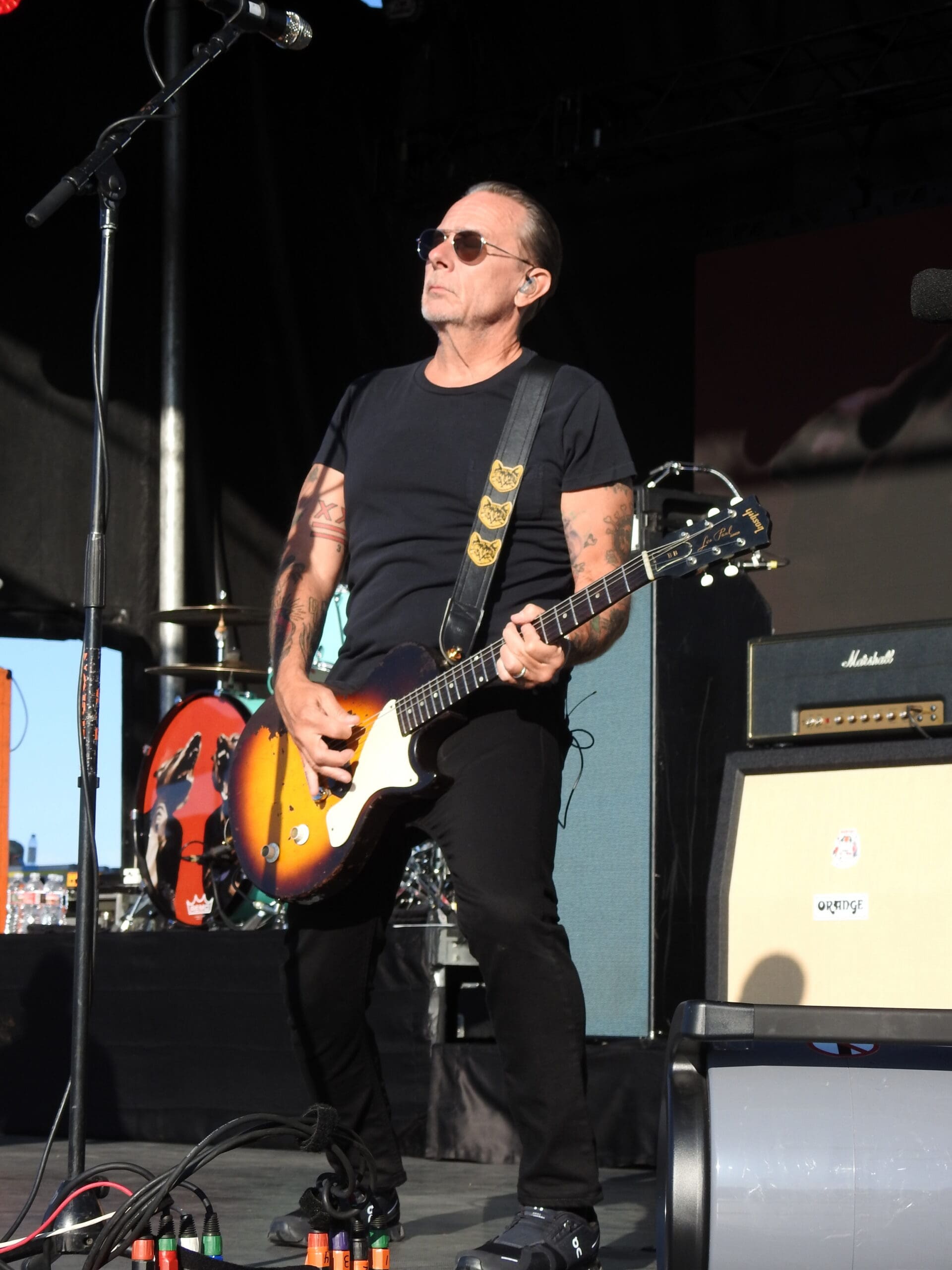
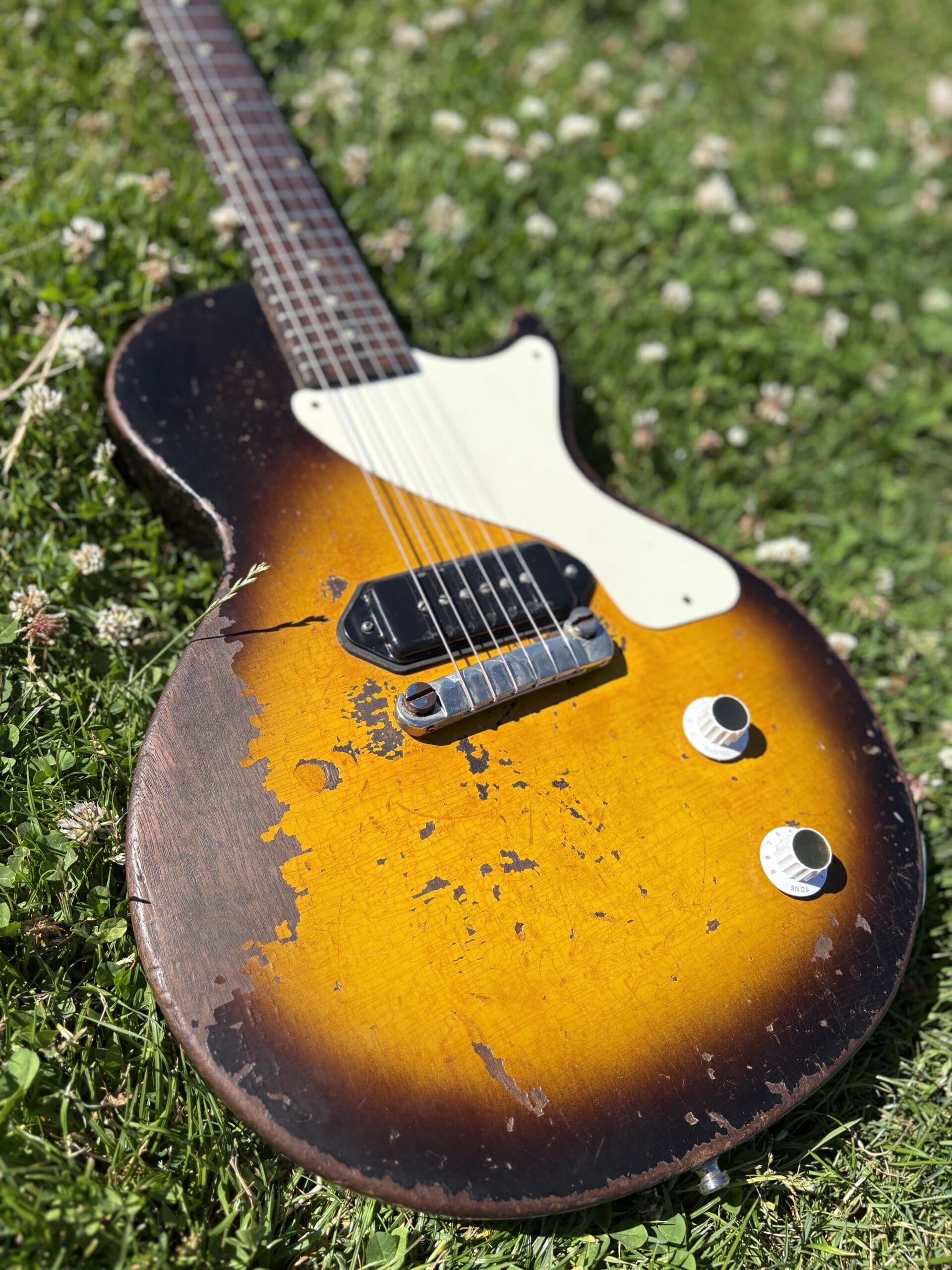
Brian’s primary touring guitars with Bad Religion are a pair of ’55 Les Paul Juniors. Brian is incredibly particular about his gear, but he’s not precious about it. But, in keeping with what Temple called, with approbation, his “fastidiousness,” Brian doesn’t like refins. Every friend of Brian’s I spoke to had a different way of describing him as a perfectionist. He is, however, completely unsentimental about gear. (Brian is the only guitarist I’ve ever spoken to for more than fifteen minutes who didn’t rue a guitar they should never have sold.) Given his minimalist/punk approach to gear, I asked why he didn’t just tour with a reissue. He explained that the older ones have more life, more bloom. And they smell better!
It’s rare to just spontaneously get into vintage Juniors. But when someone puts a Junior in your hands, it’s a revelation. Some years ago Tacoma Luthier Joe Riggio handed me his ’55, with divots in the body from when its original owner used it to drive stakes into the ground. It was the loudest unplugged solid body guitar I’d ever played. As Brian said, “there’s the least amount of things in the way of the vibration” on a Junior.
Brian’s LP Junior sherpa was Bad Religion’s other guitarist, Mike Dimkich. Dismissing complaints about tuning and noise, Dimkich described tuning more as a function of the player than the guitar. (It is very punk rock to view tuning as a matter of personal agency.) He acknowledged the noise, but noise management, like tuning, comes down to personal agency; both Bad Religion guitarists ride their volume knobs relentlessly.
Brian explained that previously, “I didn’t like P-90 guitars because they buzzed and I didn’t like wraptail guitars because you couldn’t intonate them.” But Brian thought Mike “sounded so great…and I was attracted to the economy of the guitar.” Regarding noise, Brian credited a combination of volume knob control and “getting over it.” At first, his “inner nerd” was still obsessing over intonation, but he realized—and I can’t tell you how liberating this epiphany is—“it was the idea of the lack of precision that was bothering me; it wasn’t the lack of precision itself.”
Purchase the issue to read the entire feature.
John Drenning played guitar in the hardcore bands Foundation, Zero Tolerance, New Balance, Third Man In, and a fifth band that cannot be named in pleasant company. If he missed anything, reach out to him on IG at @drenning. Author photo courtesy Tom Stevens (@NewDirection)