On May 24, 2025, the steel guitar community lost the legendary Calvin Cooke. Calvin was a husband, father, and grandfather, a man of deep faith, and a musician who made a profound impact on the sacred steel movement.
Calvin was born in Cleveland, Ohio, in 1944. His uncles were ministers in the House of God Church, founded in 1903 by Mary Magdalena Lewis Tate, known as Mother Tate. Musicians such as Willie Eason, Henry Nelson, and Lorenzo Harrison had introduced the lap steel guitar (at that time a very popular instrument in the United States) into House of God churches starting in the early 1930s, and it caught on. Many of the church’s early congregations were made up of migrant workers, and the steel guitar was an affordable and portable option for bringing music into the revival meetings. It could be used as a melodic instrument or to back up a singer, and early steel players developed a rhythmic technique known as framing, which proved an effective replacement for washboards and other percussion instruments. This was the spiritual and musical environment in which Calvin was born.
As a child, Calvin wanted to be a lead guitarist but found his hands were too small, so he put the guitar on his lap and played it slide-style with a knife. Eventually, he came into possession of a black and chrome Bakelite Rickenbacker and became the steel player in a band with his cousins. Bishop Mary Francis Keith, (head of the Keith Dominion at that time) took Calvin under her wing and, during his school vacations, she began to take him and his band with her as she traveled to different churches around the US, primarily in the Southeast.
One night, Calvin had a dream, which he considered a vision from God, of a new tuning for the 8-string steel guitar. He told Bishop Mary Francis Keith he wanted to pursue his vision, and, according to Grace Cooke, Calvin’s wife, the Bishop said, “Tonight, try it out, and if it goes over well, you know it came from God…and it’s yours.”
This bluesy, funky tuning (E D B G# E B E E) would become Calvin’s signature sound and would result in the Bishop anointing Calvin’s hands as instruments of faith. As Grace explains, “Her blessing influenced the church at large to embrace the sound…the older generation was more used to the slow, country western, mellow kind of sound, and Calvin brought speed and more of a funky, bluesy twist to the gospel way of playing the steel guitar. That’s what made him stand out. That’s what made him unique.”
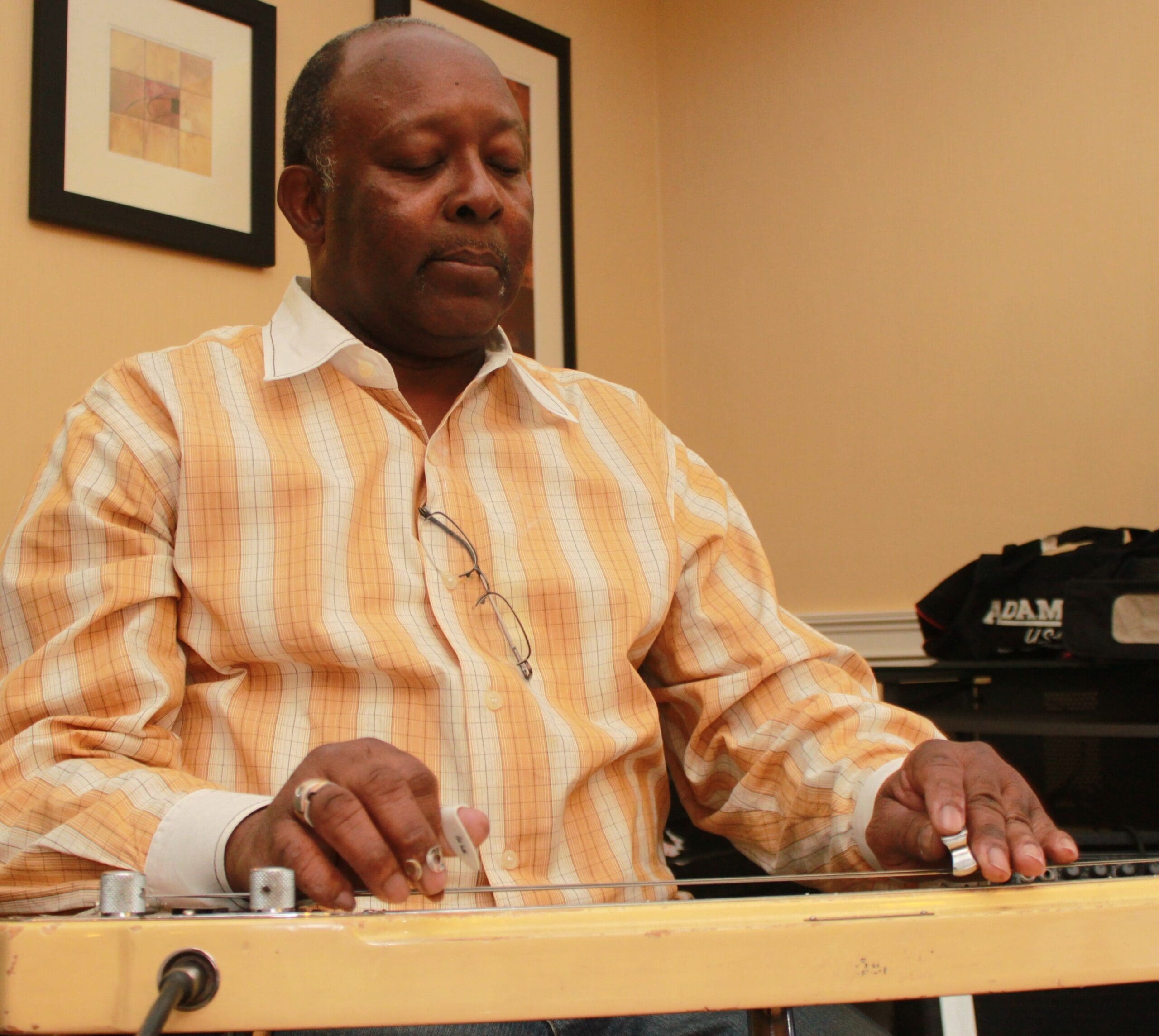
Chuck Campbell, now an elder statesman of sacred steel who grew up on Calvin’s tuning, explains that the order of the top three strings allowed Calvin to play pentatonic licks with a clarity and speed that no one in the church had ever heard before, “and he was doing this stuff back in the 1960s.”
After high school, Calvin moved to Detroit and worked for Chrysler, but was constantly touring and playing at church services on weekends. During this time, he also acquired an MSA 10-string pedal steel (found by his mother in a pawnshop), which he set up with the help of Chuck Campbell.
As with his 8-string tuning, Calvin created a unique tuning and pedal setup that allowed him to continue to develop his style. Calvin’s ten-string setup is an expanded version of his 8-string tuning, but with the addition of foot pedals, which would allow him to turn the open string E chords into an A or E7 chord. But he didn’t stop there. “Calvin was such an innovator,” Chuck recollects, “he actually started using the pedals for doing lead licks like a whammy bar, that was pretty exciting and that was way back in 1975.”
As he toured, his influence over younger players became more and more evident. “He was a little guy, but he had a large imprint,” says Del Grace, founder of Sacred Strings, the sacred steel museum in Toledo, Ohio. “He wasn’t just a musician, he was a movement. He was a trendsetter…he set the pace for a lot of aspiring musicians of his day and beyond.” This influence would start to transcend the church in the mid-90s, when folklorist Bob Stone and the Arhoolie label produced several CDs and a documentary film featuring Calvin and other sacred steel players such as Ted Beard, Aubrey Ghent, and the Campbell Brothers.
As Calvin was retiring from Chrysler after almost 30 years, he found himself with the opportunity to take his music to a new audience outside the church. Historically, this was frowned upon by the church, since the origins of the style date back to the Jim Crow era, because “the less that was outside of the control of the church, the better chance we have of holding on to it, and not getting it taken from us,” according to Del Grace. But Calvin, who had always been interested in music outside the church (his favorite band was Yes) took the plunge, hitting the folk festival circuit with his band of Jay Caver, rhythm guitar and arranger, Ivan Shaw on drums, and Grace Cooke on background vocals, who reflects: “Calvin always pushed it to the limit. He always told people: Don’t just listen to gospel, it will open up your horizons.” Sacred steel performers like Calvin would become regular features on festival stages in the USA and Europe, “bridging sacred and secular…from church services to international stages,” in the words of Del Grace.
Thanks to Calvin’s boldness and willingness to take his music into a wider world, sacred steel surged in popularity. Groups such as the Campbell Brothers and the Lee Boys started touring nationally and internationally and Robert Randolph, who grew up in the church and considers Calvin one of his mentors, has become a global star. Robert produced two CDs of Calvin’s music in the early 2000s, Heaven and The Slide Brothers. Right up until his passing, Calvin was a part of the Experience Hendrix tour, where he shared the stage with legends like Steve Vai, Eric Johnson, Ernie Isley, Kingfish Ingram, and Buddy Guy. Chuck Campbell, also a part of the tour, remembers these incredible musicians coming up to him and Calvin and saying, “I can’t believe how you guys play that thing! But Calvin was such a courageous player, he never let us be intimidated.”
As the years went by, Calvin retained his primacy in the sacred steel movement. “You can hear his influence in everybody’s playing,” says Kashiah Hunter, an Atlanta-based steel guitarist who performed with Calvin regularly in recent years. “You can hear a lot of the young guys implementing–or trying to implement–his sound.”
Calvin’s influence is most obvious in the repertoire of licks and phrases which his singular tuning (adopted by many steel players since) allowed him to do. Calvin could rake a pristine arpeggio at speed across the high strings and create precisely intonated pentatonic licks. He could effortlessly spin out single-string runs that sounded uncannily like a human voice. When singing, he used his guitar to respond to his vocals with crisp, rhythmically impeccable phrases. But his influence can be discerned in subtler ways as well. “He always played between and inside the melody,” says Chuck Campbell, “the rest of us were pushers, he was just serenading the crowd.” Chuck also notes that Calvin’s vibrato was unique: “He always made sure that I learned to play without vibrato, and to bring in the vibrato at the end of the note to give it that vocal sound.” He was a genius at building a solo break, as Kashiah observes: “He would start off real soft and subtle to make everyone pay attention to what he was doing, then he gently brought it back up…he worked it, he just completely worked the crowd. It amazed me every time.”
Even though many elements of Calvin’s style have become standard vocabulary for sacred steel players, he had a style that was uniquely his own. For example, he frequently employed a lower drone note when playing high single-string licks, adding a timbral quality reminiscent of fingerstyle blues guitar or Appalachian fiddle. This pedal tone lent his playing a more “guitaristic” sound than the melismatic style favored by players like Aubrey Ghent, though Calvin could make the guitar weep and wail with the best of them. Calvin also loved a major seventh and exploited its delicate emotional quality to great effect, another striking choice in a genre heavily imbued with pentatonic runs and blues-inspired bends. He didn’t rely on attention-grabbing fireworks to build intensity during his solo breaks; subtle changes in pitch, articulation, and phrasing were enough to communicate to the rest of the band that it was time to turn up the heat.
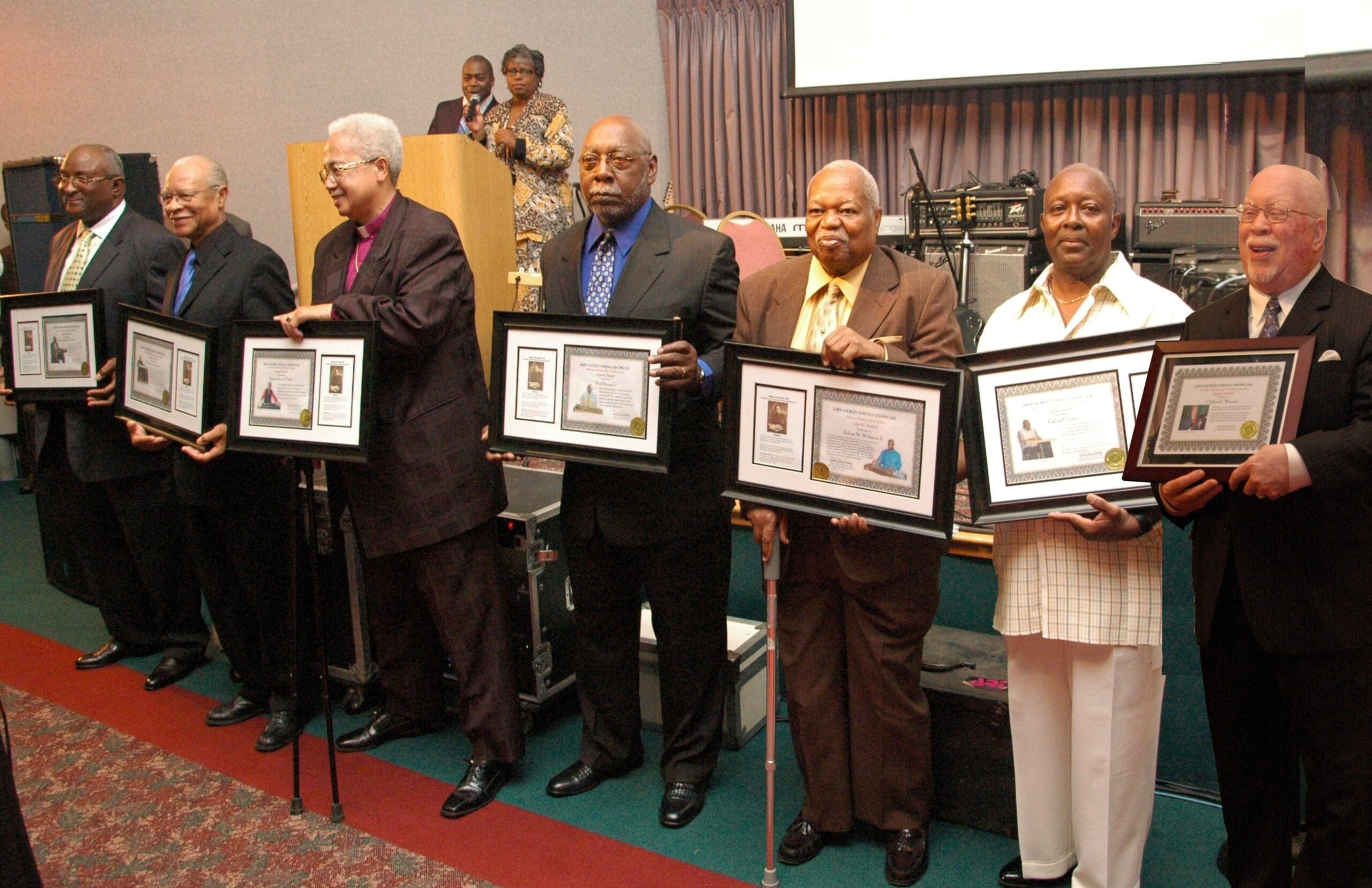
In recognition of his remarkable musical abilities and his contribution to the church over the years, Calvin was awarded with the Sacred Steel Legends Award in 2009. He was also a member of the first class of inductees to the Sacred Steel Hall of Fame a year later. He was the recipient of the Michigan Heritage Award in 2011. In 2024, he was able to attend the grand opening of the sacred steel museum, of which he had been a major supporter. Calvin, teary-eyed, toured the exhibits with his children and grandchildren. “When I see this museum,” Del Grace remembers him saying, “this is my thank you for the hard work.”
Calvin’s work may be over, but his legacy continues to live on in ways both large and small. “He added an element of personality to his position of being one of the greatest steel players…it was a thing which brought unity to all of us. That was on full display at his funeral. Where we would normally be rivals, we were family.” And at the time of his death, Calvin was mentoring his wife Grace’s nephew, who at six years old was deeply inspired by Calvin’s playing and already showing signs of promise. As Calvin put it, “He’s got a good hand.”
There are a number of musicians who could play the same notes as Calvin, but very few who had an impact that transcended generations and boundaries. Calvin always attributed this to his faith in a higher power. When he played music, he said, “I want them to feel what He gives us through our music. No matter if it’s secular or gospel music, I want them to know that I didn’t get this on my own, I was blessed to learn how to play this, and we’ll try to give them something they’ll never forget and play from our heart….I want you to feel what I’m doing, and if He touches me to do it, I want him to take it from these strings and make that SOUND penetrate from here to the heart to the rest of the body and make them say…I never felt nothing like this before.”
Thank you for your music, Calvin. You will be greatly missed.
To learn more about the sacred steel movement, visit https://sacredstrings.com/.
Sources:
Interview with Calvin Cooke, conducted by Bob Stone, various dates
Interview with Calvin Cooke and Kashiah Hunter, conducted by Natalie Jordan, 7/7/2023
Interview with Grace Cooke, conducted by Raphael McGregor, 6/20/2025
Interview with Del Grace, conducted by Raphael McGregor, 6/21/2025
Interview with Chuck Campbell, conducted by Raphael McGregor, 6/24/2025


