“One can hear so many of the sounds and feel so many of the feelings that, moving forward so steadily and so eloquently (and successfully), I identify as Julian. His ability to uplift as well as astonish are fully in evidence on World’s Fair; unvarnished and direct, stunningly beautiful while eschewing sheen or artifice of any sort.” –Nels Cline
Reflecting on World’s Fair, his remarkable solo acoustic record from 2015, Julian Lage remarks, “I’ve had the great luxury and privilege to see it change over the last decade, and see certain things revealed.” It’s an album that has acquired beloved status for those of us who worship at the altar of acoustic guitar. Matt Munisteri, who co-produced World’s Fair, was presciently on-mark when he wrote in the original sleeve notes that “this music will cast a long shadow across an ever-widening terrain.”
World’s Fair was an important staging post in Lage’s career. Known for his collaborations with Chris Eldridge, Nels Cline, and Fred Hirsch, it was his first studio foray into solo acoustic. As Julian intimates in his foreword to the World’s Fair Songbook (link), the experience fundamentally changed his relationship with the acoustic guitar. “[It] taught me how rare and beautiful it is to hear a single guitar in all its spaciousness, delicacy, and elegance–and how I could begin to navigate space and time in ways that wouldn’t be as obvious in a group setting.”
The plan was to meet up in Melbourne during the Australian leg of the World’s Fair 10th anniversary tour for a retrospectively-slanted conversation centered on the record. In the end, Julian’s promo commitments and a crazy-tight travel schedule torpedoed an in-person interview and we reconvened on Zoom a few weeks later.
At home in New York, his circadian rhythm restored to Eastern Standard Time, straight off the bat Julian is his customary super-engaged, friendly, relaxed self. A few seconds into our call, he breaks off apologetically to attend to their new puppy who on hearing Julian’s voice has woken up and soft-paw scrabbled to his feet. With pup safely secured in his pen, we settle down to talk. Over the next half-hour we alight on vulnerabilities, narrative arcs, Segovia, noise floor, and how one instrument can carry a complete musical statement… and a new favorite acoustic guitar with vintage vibes.
FJ: In Melbourne, you prefaced the performance by describing it as a Book of Music. The expression would seem to encapsulate World’s Fair perfectly–a musical narrative of pages, sentences and phrases told through rhythm, silence and touch.
JL: Well, I grew up hearing that term. [John] Zorn uses that term because it quite literally amounts to a book of pages if you take all the charts and everything. I have a tendency for a sense of cohesion when it comes to songs for a recording. World’s Fair is very specific, you know? It’s about the specific agenda in a specific world of drama, if you will. In playing it over the years, I realized like, oh yeah, this was music that was meant to be together. So, it’s definitely with a sense of intention that I’d announce and think of it that way.
FJ: The running order on the record unfolds perfectly, nothing is out of place.
JL: You know, we’re all students of music, and there are as many ways to put a record of music together as there are people. Yet there seems to be these through-lines that I keep coming back to about arc and withholding certain things, especially with solo guitar. Maybe being conscientious not to do everything you’re capable of right away, you know? Or letting things have their moment or at least serve a function dramatically. Compared to having one song and the next song is basically the same song and so on. But that can be cool too. It doesn’t really matter. World’s Fair has become its own entity, which is nice, at least from a narrative point of view.
FJ: The foreword to the World’s Fair Songbook hints at some vulnerabilities in approaching solo guitar?
JL: Yeah, that’s true. At the time, it was so novel. It’s still novel to me. I think having not really done concerts and making a record presented some cool challenges. It was absolutely terrifying, you know. But I liked that part about it. I really did. I don’t know if I view it as terrifying in the same way now, but it’s rather illuminating. Wherever you are in your guitar playing. And that trip to Australia was no different. I thought, oh, this is where this music is now, cool, and then it’s somewhere else a week later. So, there’s something that might be a little more… I don’t want to say exposed because we’re always pretty equally exposed whether we’re alone or with a band… but it’s a nice snapshot of a lot of elements coming through one guitar. Where someone is personally, musically, “guitaristically,” physically, emotionally on display.
FJ: I understand Segovia and Barros were big influences?
JL: Yeah, well, those influences they’re huge in my life, not only for solo guitar, but for performance and composition. But absolutely, through the lens of solo guitar, the question remains the same: What’s so compelling about a single instrument and a single voice? In making World’s Fair, I had it backwards. I really did believe I had maybe a poor mentality, thinking that I needed to do more to make up for this lack of people around me playing. And when I did that, it garnered a very particular sound and results. I was able to reflect and go, no, this is one of the few times where you can actually be quite vulnerable and leave space. But not to conflate that individual nature with weakness or any sense of lacking.
In a way it’s a mindset shift, isn’t it? Under the scrutiny of a microphone, your things that might otherwise feel rather transient become a big deal. In relation to Segovia, those early recordings of his had a lot of noise in the recording, unrelated to his playing. In the electricity and the noise floor, so to speak. So, we have some of that on the record deliberately to contextualize the guitar. Rather than saying, “Well, get a perfect guitar sound, pure and beautiful, and that’s all that matters.” That maybe left us feeling a little bit cold. Things like reverbs, the sounds I involuntary make while I’m playing, the noise floor of the microphone… they all add up to something.
FJ: Can you talk about the role of Matt Munisteri and Armand Hirsch in achieving the intimate sonic footprint on World’s Fair?
JL: Absolutely. Armand Hirsch is one of the most brilliant musicians and, at that point, we were around each other all the time. It was a real privilege because that record could unfold over time, and he had that superpower of translating the evolution of the process into a sonic medium. He was no stranger to what the songs were, how far they had come, what we thought was possible… it was deeply integral. And Matt Munisteri too. He was looking at it from a more globalized conceptual point of view… knowing my playing, what would stand out, what would be cool to feature, what hasn’t been documented? So, you’re absolutely right. The conversation was consistent.
FJ: What are two lessons you took away from the making of World’s Fair in the context of what you’ve gone on to do over the last decade?
JL: It’s a great question. Well, I’d say one of the lessons would be that having heard myself recording and playing that music, it’s such a humbling reminder that the sound of a guitar is enough. You know that’s quite miraculous, a machine that makes sound and resonates. And like everything in life, you keep getting reminded it’s not about us. It’s not about I had a great idea and I did this. It’s not that. Making World’s Fair taught me that there’s a high degree of humility needed. You serve the music, serve the instrument, serve the resonance of the room you’re in to the best of your ability.
The second part of that lesson is that over the years, having played it live, that music was very much at its beginning stage by the time we recorded it. It’s only gone on to grow and I’ve learned a lot from it. It’s almost cliché, but that common notion that a recording is really a snapshot, and then it’s different the next time. I still love the original, but I like that it wasn’t limited to that recording. It was that music got me into playing, taking that role seriously and I’m grateful for that. I don’t know if I’d have taken it seriously unless I started with a higher stakes project like that.
FJ: The compositions on World’s Fair are infused with such humanity. In “40’s”, there’s an ascending chordal move–Gmaj13, Em11, Am11. Beautifully expressive, uplifting, transcendent, curious, slightly melancholic… I tried it out yesterday and it left me in a great headspace!
JL: That’s great you did that. That’s what it’s there for, you know. Suddenly you go, ‘oh, that’s a thing!’ and then you do what you want with it.
FJ: Reminds me of free-jazz pianist Cecil Taylor’s comment about great artists… rather than getting involved with discipline, they get to understand love and allow the love to take shape!
JL: Jeez, man, it’s amazing. It’s so fun. The fact it’s solo guitar really doesn’t matter. Of course, it’s part of the message and it’s the medium, but it’s not the point. When I listen to the masters, whether it be Julian Bream, Segovia, or Leo Kottke, I’m struck with that too. I grew up thinking it was one thing about the guitar, but then I have even more respect and humility when I listen to those players because I go, wow, they are really transcending the guitar. The thing that’s moving it is their sense of storytelling, and that’s a fabulous thing to shoot for.
FJ: You’re known for your kinesthetic approach to playing… shifting hands and feet, small vocalizations, facial expressions, and whole-body movement. It’s compelling to watch.
JL: You go in thinking this is one person playing music, but one person is full of so much stuff, you know. There’s really no such thing as seeing just one element at play, and I felt that on that tour. Melbourne happened to be in a beautiful hall, and that was a character. Look at this big room, sounds great, and then there’s this one person playing guitar. We went on to other shows that were far more challenging because they weren’t proper concert venues. You don’t have the scale and it’s a different kind of intensity. It’s one of the beautiful things playing solo. I’ve had the joy of seeing the juxtaposition, and typically a concert hall is a really nice place for it.
FJ: I’m intrigued by your choice of song titles on the record. It reads like a travel log–“Peru,” “Japan,” “Missouri,” “Ryland”…! Were those songs written in the lead-up to the record or had they been in your back pocket?
JL: No. Those were very much written for that record and it’s true, there’s something about those titles that are interpretive. It’s what you feel about it and you bring those feelings to the table. But there’s a neutrality about some of those names, for whatever reason, they seemed appropriate. “Japan” seemed appropriate, but it didn’t have to be called “Japan.” Then you have “Missouri.” They’re setting a certain geographical stance. Again, that may be neither here nor there, but it’s interesting. I remember talking to my father about this years ago. Names take on meaning when they fuse with compositions and sometimes they have to strike a balance of being compelling and neutral at the same time. My favorite titles are the musicians who understand that poetry. Those are the ones that stand out to me. You go, wow, they really got me into a place. But it’s very personal. I have to play, name things, give them titles that you can get away with that match your disposition. I appreciate you picking up on that because it does matter to me.
FJ: A personal favorite is “747.” At first you think, “Oh, that’s the airliner!” But turns out you named the song after a Swingline stapler. Super-playful.
JL: Well, numbers are words, you know.
FJ: Can we talk about your signature Collings OM1-JL, which is based on the 1939 000-18 you play on World’s Fair? Nully from Collings recalls working on the neck spec back in the day when Bill was still around. They’d line up the neck options, each with a different half-inch strip infill (maple, carbon fiber, spring steel, and ebony) for you to try out? You’d play the guitar, make notes and their set-up guy would swap out the neck for the next one?
JL: That project was complicated! The whole time I was keenly aware that they didn’t have to do this. I was essentially coming to Bill excited to be working with Bill, and Nully, Mark, Bruce, Clint, and Aaron. I came with a deep reverence for what they already did. By the same token, I was challenging them. What if we don’t have a guitar that’s high gloss? What if you have thinner top woods? What if the necks aren’t reinforced in this certain way?
I proceeded with caution because I knew everything I asked for was contradicting what they had built their company on. Fortunately, Bill was eager to see something from a different perspective, and the premise of that conversation was that the Waterloos were sounding so great. Whatever you’re doing here is working.
There’s a parallel in the world of Martin-style guitars, even though they’re not built the same way. They certainly benefit from some of the same features in terms of finish, weight, density of wood, the thickness and thinness of wood. They went through a lot of guitars and quite frankly, we got to a point where it didn’t seem like it was going to happen. Then somebody came in and basically said, ‘This is the combination of body neck you’re looking at,” and it was really wonderful. Guitar builders aren’t just guitar builders. They’re interacting with where they get their wood, who’s cutting their wood, what materials they have at their disposal. You have to fit into their ecosystem. They were at a point where they had the bandwidth to consider something different.
FJ: After all the experimentation, it turned out the neck you all liked best was the one Collings still use today: No internals other than the rod. Nully says it’s exactly this sort of mess-around project where you learn so much by confirming what you know and stuff you don’t.
How’s the 000-18 faring these days?
JL: I still have it. It’s been in disrepair for many years. The top was sinking at a certain point, so I put it away with the tension off and I’ve left it with a friend to fix. But I did have it up and running briefly, maybe a year and a half ago, and I tried and liked it. It made sense as a recording guitar but live it didn’t quite make sense.
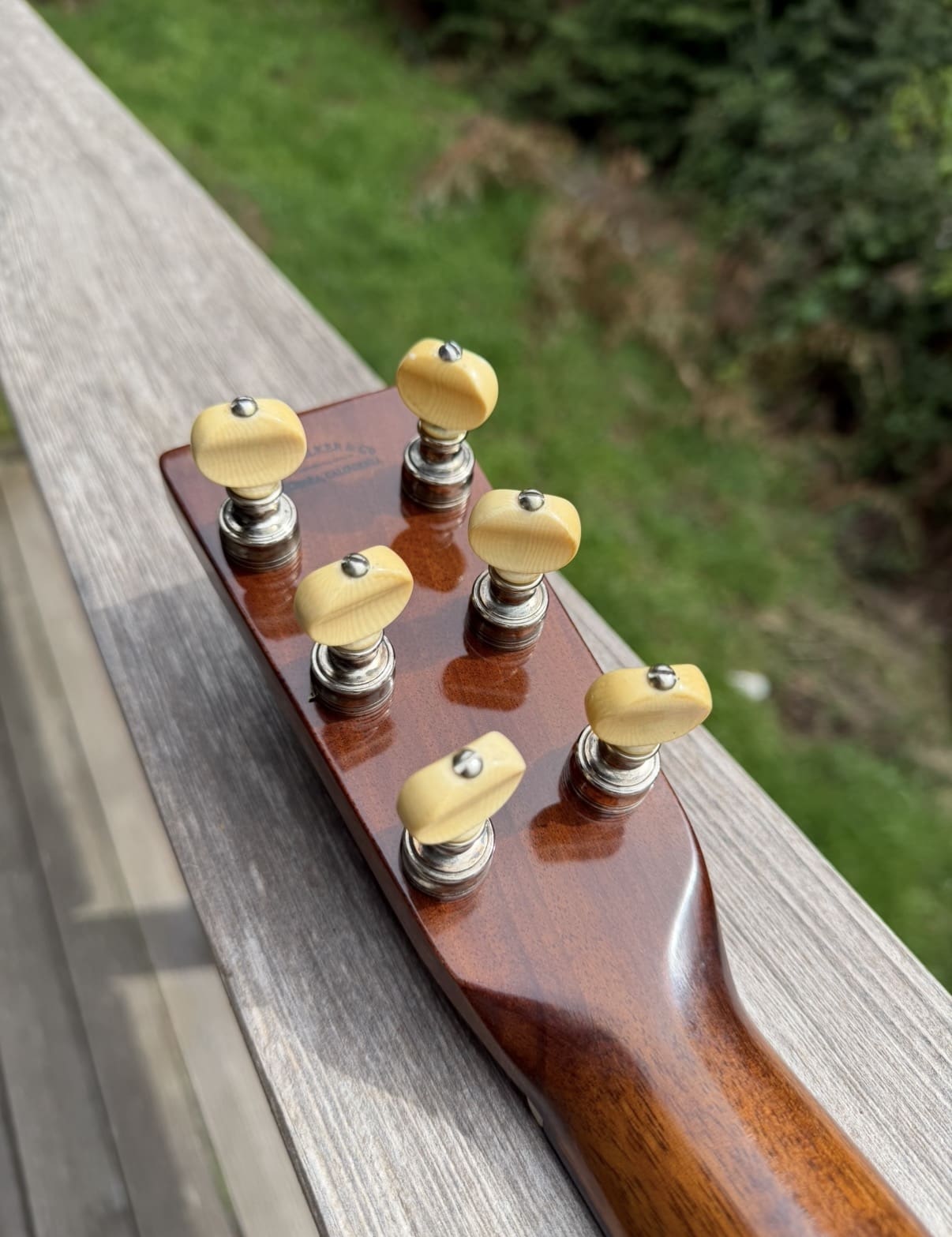
These days I’ve been playing a Michael Walker guitar that I really love. Bar-fretted, OM-18 style…it’s fabulous. What I’ve always been moving towards is something that replicates the sound of an early ‘30s OM-18. Growing up, our local guitar shop was Eric Schoenberg’s. Mr. O.M. himself. I forgot about that sound then; over the years, I thought, that’s the timbre I’ve been looking for. The 000 has some of that, but it’s shorter scale. The Collings has some, too, because of its longer scale, but it doesn’t have other things. The Walker has all those features. Michael is a fabulous builder. I wanted to bring it to Australia, but it’s got banjo tuners, and they didn’t fit in my Hoffee case.
Coda
I sought out Bill Frisell to garner his thoughts on Julian’s creative trajectory. His reply was informed by an Instagram post he’d seen earlier that day of Julian playing at the Crossroads Festival alongside Jorge Roeder and Nasheet Waits. “He’s evolving so fast, and it keeps getting deeper and clearer. His curiosity for everything around him. He’s not stopping!”
When I relay this to Julian, his reaction is typically warm and generous: “That’s sweet of Bill. I’m grateful to be doing this.”
Evolution–Curiosity–Humility. Hallmarks of Lage’s philosophy and sensibilities that hark back to the making of World’s Fair.
Above photo of Julian in Adelaide, Australia: Matthew Hocter