Touring musicians often bond over simple things: Favorite restaurants, hotel hacks, inside jokes, or a good book.
When Tyler Ramsey and Carl Broemel first met on the road over a decade ago (Tyler was in Band of Horses; Carl is in My Morning Jacket), they connected over a shared love for instrumental guitar records. “Isn’t it fun to find an old reissue of a cool guitar record that has a bunch of mystery to it?” Broemel asks. “There’s a mysterious guy who only made one record and it’s from the ‘70s and then he went off and he was a carpenter or whatever. I love that mystery.”
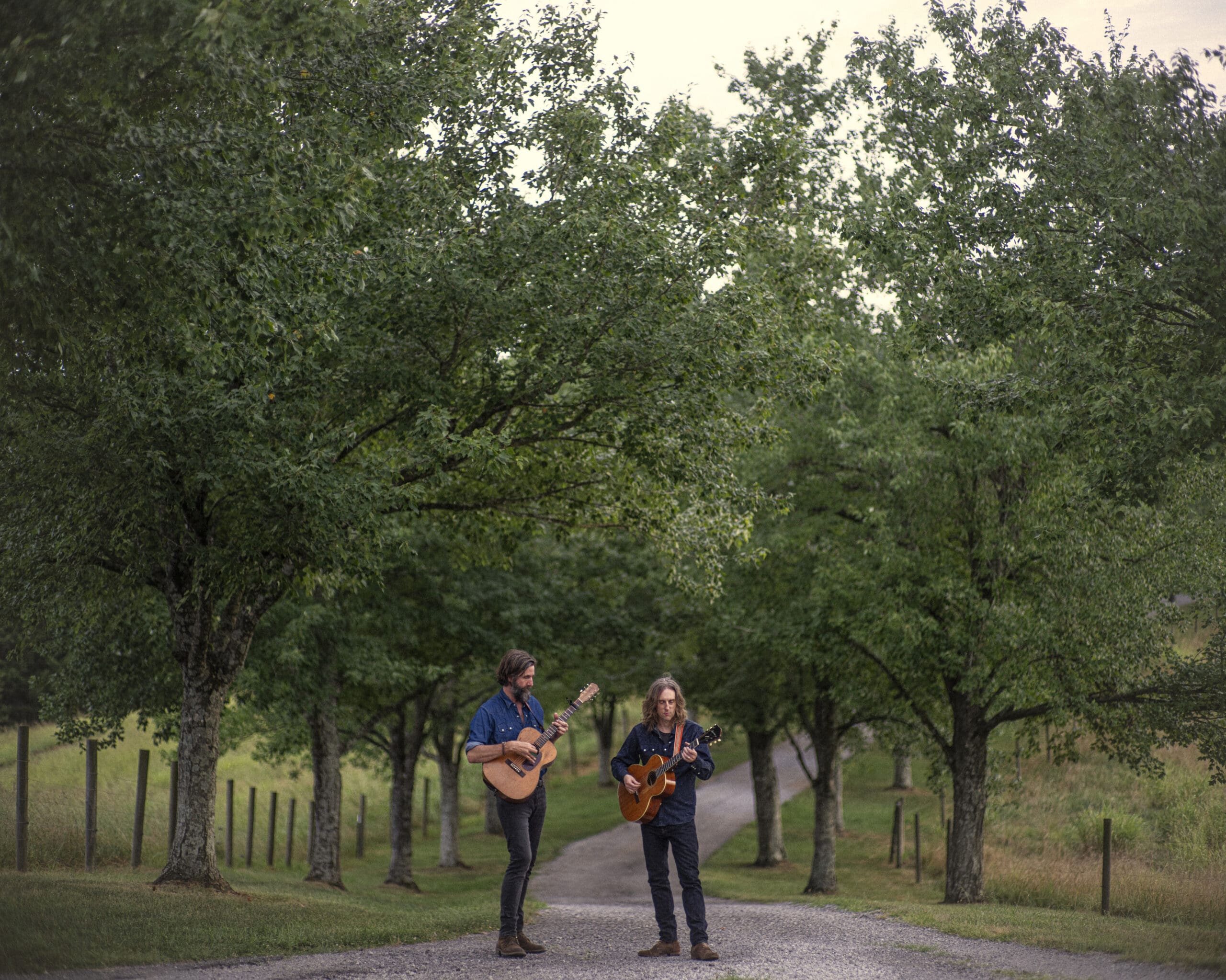
Having played together over the ensuing years, Ramsey and Broemel have just released Celestun, their first duo record. During the COVID lockdown, they exchanged tracks back and forth through the internet. When restrictions were lifted, they recorded the remaining parts at Broemel’s Nashville studio.
Like some of those mysterious private press recordings they love, it’s a throwback of sorts, a beautifully subdued record of intricate guitar interplay, a soundtrack for a movie that doesn’t exist. The tracks with vocals – “Nevermind,” “Flying Things,” and “Sail Away” – evoke a bit of a Topanga Canyon vibe, but listen closely and you’ll hear another big influence, bluegrass great Clarence White.
Fretboard Journal: When did you guys first meet?
Tyler Ramsey: Back when I played in Band of Horses, we opened some shows for My Morning Jacket. I’m not even sure how many shows, maybe 10 shows? So we got to know each other a little bit then, but not a ton. I was trying to stay out of their way most of the time! And then we reconnected. Carl was coming through town here while touring.
It was [Broemel’s 2018 solo album] Wished Out. His backing band was Steeleism from Nashville and I went to go see him play and we talked afterwards. That’s when the little spark of like, “Hey, we should try and do something together at some point.”
We ended up just booking a tour together before we even had a chance to really know what was going to happen. It happened just quickly. It worked out pretty good.
FJ: And was that tour more singer-songwriter song-based or did you know what you were getting into with the instrumentals?
TR: The plan was we’d play on each other’s songs. We’d go back and forth between Carl’s songs and my songs and accompany each other and sing harmonies. We brought a bunch of different instruments out. I basically just drove to Nashville to Carl’s place and we rehearsed for maybe a day or two and then hit the road with all of our stuff. It was pretty magical.
Carl Broemel: We were already playing “Elizabeth Brown,” one of the songs on Celestun. That became part of the show. We also started doing a flatpicking bluegrass thing just to make the show have more variety.
The album was spawned from those things, trying instrumentals and being like, “Hey, every song doesn’t need to have vocals.” And it was fun to play.
FJ: Carl, on one of your Instagram posts you talk about Tompkins Square records. Were you listening to that sort of music – John Fahey, Robbie Basho, etc. – before you and Tyler collaborated?
CB: A little bit. Tyler was opening my eyes to it. He’s more steeped in that genre than I am. One of my favorite acoustic guitar players is Clarence White. I love Clarence White. He’s the guy that I’ve studied the most and tried to learn his approach to the acoustic guitar, which is crazy. To me, he’s like Eddie Van Halen. I love Eddie Van Halen as much as I love Clarence White as much as I love Nick Drake.
TR: I’ve known Tompkins Square for a long time. For my first-ever solo self-released, self-titled solo record, I went up to New York City and met [Tompkins Square founder Josh Rosenthal] at a record store. I was really gunning for that record to maybe come out with him. So we met and I handed him some copies of this CD that I had burned myself. He liked it, but he didn’t put it out. We’ve stayed friends over the years.
My guitar path has been that kind of [fingerstyle] music. I came across a Michael Hedges cassette in some random New Age store in Brentwood, Tennessee and my mom bought it for me.
And then my uncle gave me a copy of Leo Kottke’s A Shout Toward Noon with Guitar Music on the other side of the cassette. From there, it was all in, finding all this weird stuff. Josh at Tompkins Square is great at digging stuff up and the compilations he puts together are good starting points for finding whole catalogs of people that I wouldn’t have known about.
FJ: Fingerstyle comes in many forms, from Michael Hedges to Kottke to Robbie Basho’s sprawling output and more. Tyler, what style do you gravitate towards?
TR: I gravitate towards more concise, composed lyrical instrumentals. Composition is part of what I try to do with it. I love sitting around and I could play for an hour just noodling on a theme or whatever, trying to play a raga-y kind of thing, but that’s not normally what I present to people that would want to come see me play. I’d rather play a concise, written out, or not technically written out, but a little composed piece of music. I do a lot of alternate tunings as well, so that always leads to new territory and stuff.
FJ: Did you record Celestun at Carl’s studio?
TR: We did. I think the first thing that was the song, “Celestun.” I recorded it here at my place and sent it to him. It was unplanned, but he sent back his pass over the top of it, and then all of a sudden, we were like, “Oh, let’s do this.”
CB: Yeah. Half the record we did in the same room and half was during the pandemic, long distance. He sent me “Celestun” and I sat with it. It made me realize that sometimes sitting with something and working on it for a while and getting the arrangement right is really cool. Also, doing things live is also a great way to record, as well, and we can do both. It was really a unique experience to get “Celestun” and listen to it a bunch of times and just sit with a guitar, try to play along to it, come back to it the next day, try to beat that, maybe do a couple edits here and there.
So I was learning where he left space for me to elaborate or just accompany. I really love that mindset. Should I step out? Do I need to accompany?
I think we both do that naturally and we’re trying to build that skill as we play more and more together. Then, he sent me “Elizabeth Brown” and I sent him one. Thankfully, things were wrapping up with the pandemic and we were able to schedule a time to get together. Originally, it was all going to be instrumentals. We didn’t even know we’re going to release it.
It was just something to do. It’s cool for me being in the music business for this long and strip things back and just start over again. Guitars, no equipment, no tour, no expectations, nothing.
FJ: I have to imagine that it was a lot easier to make spaces for each other when you finally were in the same room for the second half of songs?
CB: Oh, yeah. And then it does become a live action back and forth, stepping up or accompanying. We sat and played “Sail Away” front to back and that was it. I was like, “Wow, this is taking way less time. This is amazing.”
TR: My recording technique is based on my limitations. As a person who can operate any kind of recording program, I end up doing everything front-to-back mostly. If I’m recording a guitar piece, it’s like “press” and “record” on a tape recorder. I don’t even know how to go back and edit. If I don’t get it right, I have to do it over again.
What I was sending Carl might’ve taken me 15 passes, but finally, I got it right. And then when he was talking about filling in the spaces or leaving the spaces in the songs, it was fun to get them back. How much they were elevated by Carl’s playing just blew me away and made me so happy. Everything we’ve passed back and forth has come back better, elevated by us joining forces.
FJ: What kind of guitars did you use for this effort?
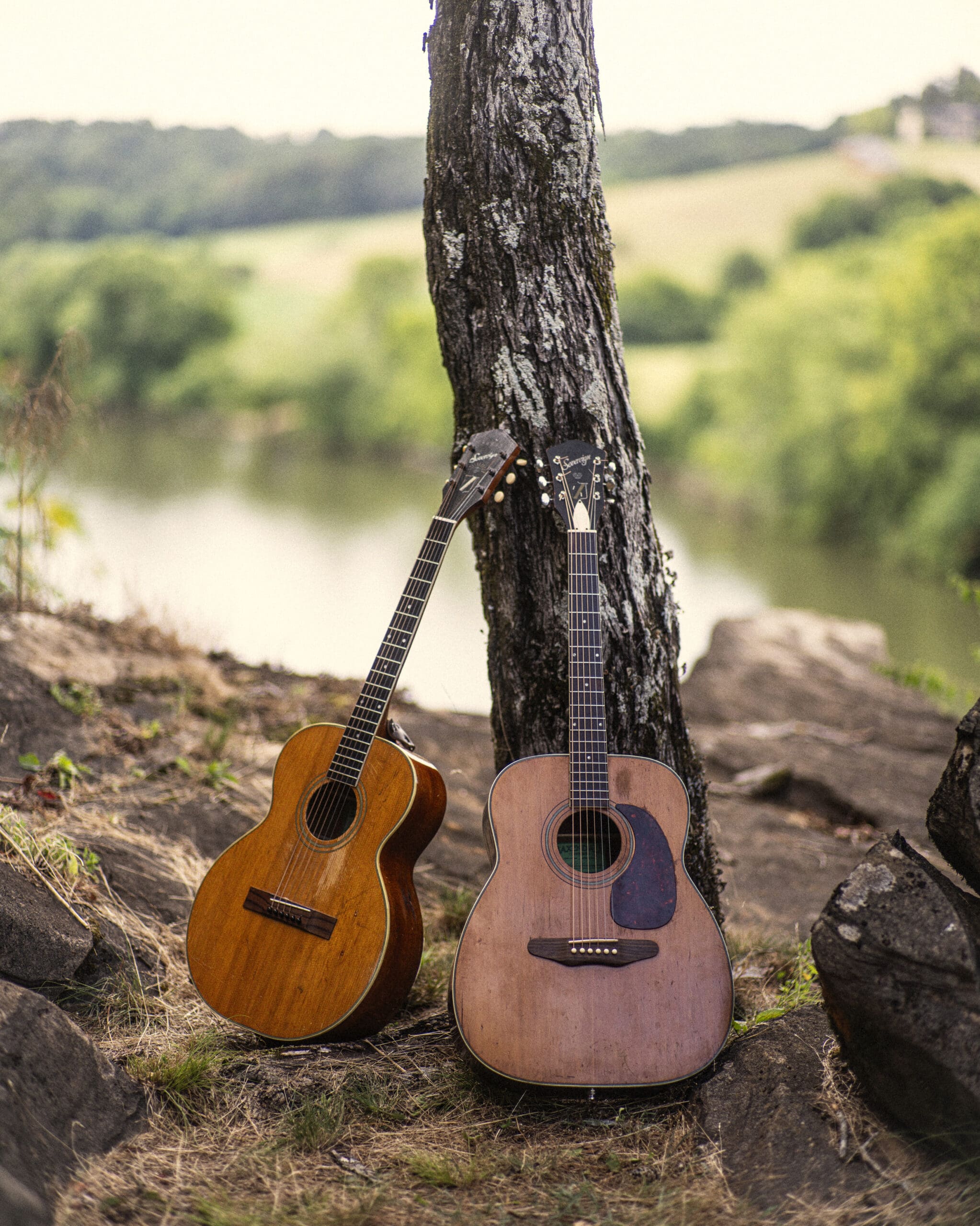
TR: My favorite acoustic guitar is a Harmony H162. I believe it’s from the ’50s, from [luthier and conversion guru] Scott Baxendale…
CB: I have two of them, too. Scott got his hooks in me when he had his store in Athens, Georgia. If you walked in there, you left with a guitar because they’re so inviting…these old beat-up instruments, but he makes them so you can actually use them. I have three of his guitars.
TR: Carl’s to blame for me having three of his guitars as well. When we did that first tour together, Carl was letting me use one of his Baxendale conversion guitars and I absolutely fell in love with it. Then we got done with that tour and somehow I accidentally ended up in Athens on my way back from a tour and stopped by Scott’s shop. I was like, “I’m getting one of these.” So that’s the one that I was just talking about.
FJ: How do you separate the sound of two acoustic guitars in a duo setting?
TR: They’re different styles. I think mine’s the H162. It’s a small body, like a 000. Do you have two of the [Roy] Smecks, Carl?
CB: No, one’s a Sovereign, like the Jimmy Page acoustic. And the other one is the Roy Smeck model. It’s interesting. We recorded one song on the record where we did it around one microphone and that was just supposed to be a demo. We were like, “You know what’s amazing? I can’t tell who’s doing what.”
To me, I want to make one big guitar. I don’t want it to be like, “Oh, that’s definitely Carl and that’s definitely Tyler.” I’m like, “Fuck it. Everything’s blending together.”
FJ: Do you know what Baxendale did to modify these old Harmonys for you?
CB: I believe he resets the neck and re-frets the guitars usually and then he re-braces the insides. And then he puts a K&K pickup in there, which I like because I never have to worry about the battery.
For me, instruments are a funny thing. I would love to have a vintage Martin. I have an old Gibson small acoustic because it’s great. But for what we’re doing, these guitars seem to work. They’re interesting sounding. You can’t put your finger on it. They don’t sound necessarily like a Gibson or a Martin. They’re in between. They’re a little rough and ready and I like that about these guitars.
FJ: And how did you record them? What microphone did you use or did it change from track to track?
CB: When we were together, we used KM84s and I think Tyler recorded some of his stuff which was a [Shure] SM57. I would record with a ribbon mic to have a slightly different sound, but that’s basically it.
TR: I’ve got a couple of the mics, but once again, I’m not a proper engineer and this isn’t a proper studio, but I’m able to capture things that are passable. So, yeah, the 57 and I’m not even sure what else.
CB: A lot of the songs ended up going on to my four-track. We didn’t record to the four-track most of the time, but I did dump stuff on and off of there to try to achieve a little bit of that lost acoustic guitar record sound.
I really enjoy what tape does to an acoustic guitar. A lot of times people talk about recording the tape and it’s all about the low end and the bass and the drums. For me, it’s all about the acoustic guitar sound because the very highest part of the acoustic guitar sometimes is irritating to me. And if I put it on cassette, it gets a little mangled up there and I think that’s how we’re supposed to hear it, honestly. Either in-person or off a cassette to me is how you’re supposed to hear an acoustic guitar.
FJ: I love that you guys were just doing this to get through the pandemic. At what point did you know you had an album?
TR: That’s a good question. We had a few things that we started out with. Then, we were like, “Well, let’s just finish, round it out.” But it’s wild because this is the easiest album I’ve ever made in my life. The songs are definitely challenging, but the whole process of making the album just breezed by in this really relaxed way. It just felt like no effort to me.
FJ: And are you guys still trading songs back and forth like before?
CB: There are a couple already in the folder, a couple demos. I’m just stoked.
FJ: Carl, you were talking about Clarence White. Who are your living acoustic guitar heroes?
CB: I just got hip to Cameron Knowler. There’s a playlist of stuff that Tyler made that’s amazing, but Clarence is really my guiding light. Once I started trying learning bass intro to flatpicking and then I heard him do it, I was like, “I really like his approach to it.” He made all these cool little tapes for his students that are amazing to listen to. So I’m trying to slim down who I’m studying. I’m studying Clarence and Eddie Van Halen right now. That’s my thing.
FJ: You could spend the rest of your life doing that.
CB: Exactly. It’s fun to play “Hot for Teacher” and then “Black Mountain Rag.” They’re both great. I’m accepting myself that I am an ’80s rock guy. We just played some metal songs on tour and I was like, “Man, I’m feeling real comfortable right now.” And so I can’t deny that that’s part of who I am, so I’m leaning into that nowadays.
FJ: What about you, Tyler? Who are you listening to?
TR: I definitely have been following Cameron on social media for a while and really enjoying what he’s doing, but I tend to go backwards a little bit. I still will put on Michael Hedges’ Breakfast in the Field or those Leo Kottke records. I’m fully embracing my New Age nerd status.
I still have a huge love for country blues and ragtime, too. I spent a lot of time learning Mississippi John Hurt stuff.
FJ: Well, you did it. Even with your differing music tastes, you made a really cool, mostly instrumental acoustic guitar record. It’s almost unheard of to pull that off.
CB: Yeah, we were joking with someone else that we made the record we knew no one wanted, but we wanted to do. When I play with Tyler, I feel that spark and that challenge always and I get energy out of it. I’m just excited for people to hear the album and they can make what they want out of it.
Listen to Celestun here.